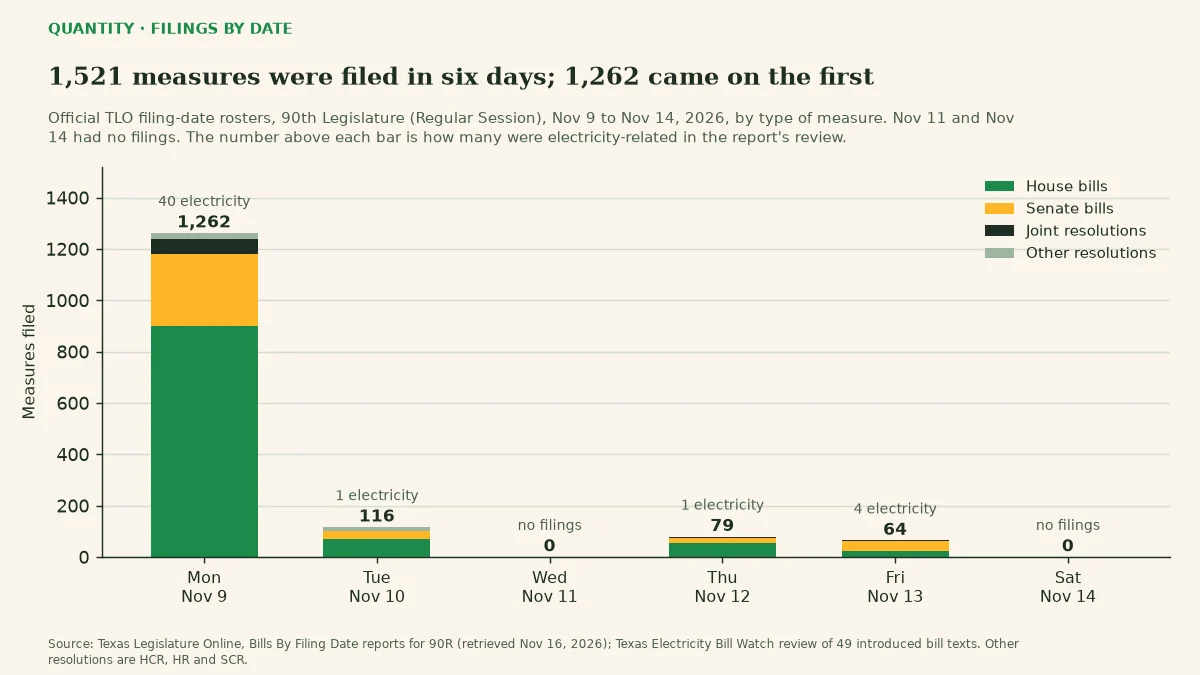
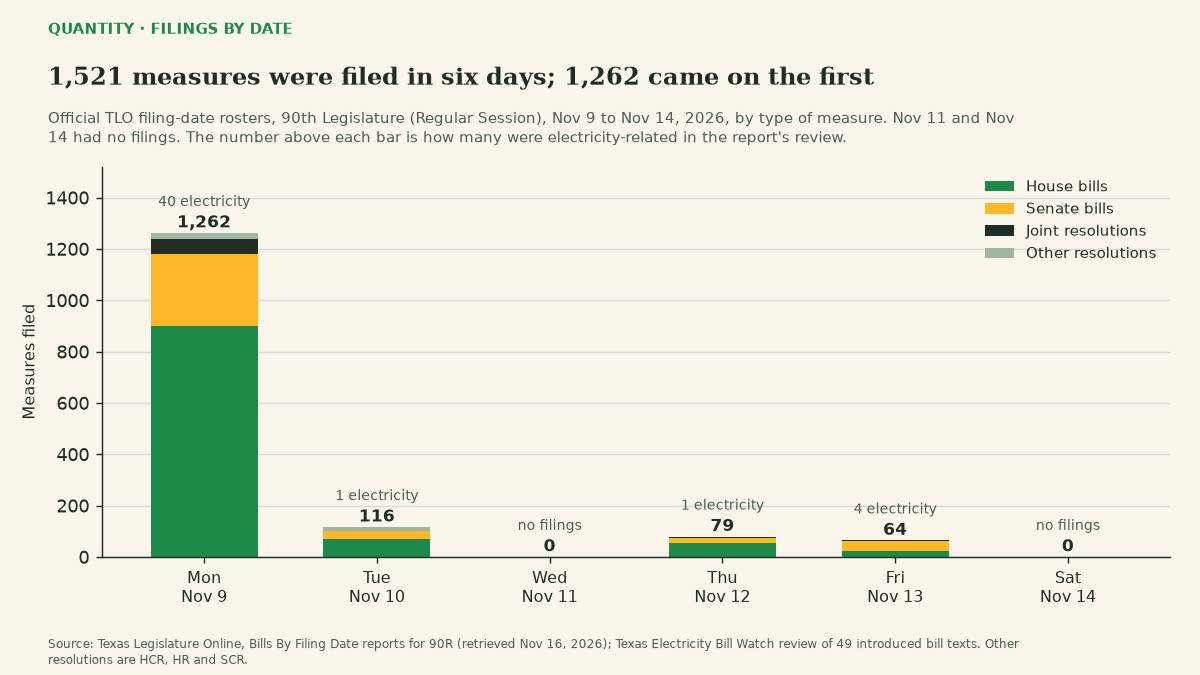
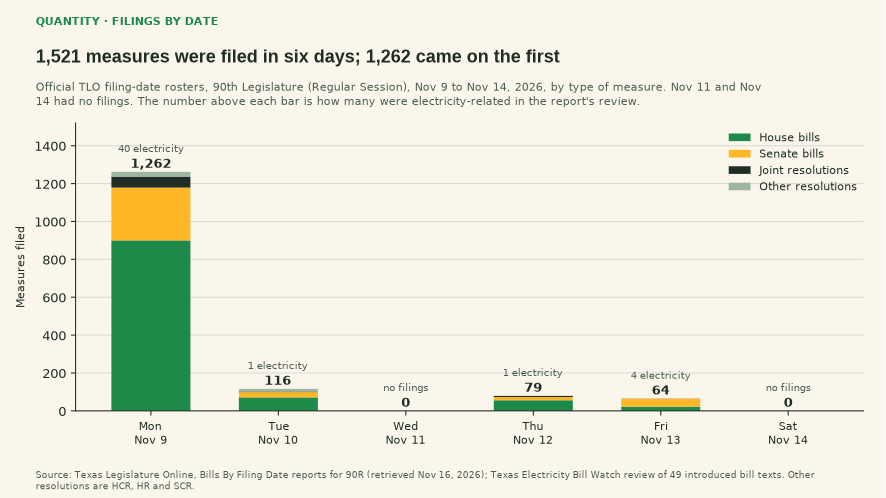
November 9, 2026 — 1,262 official filings
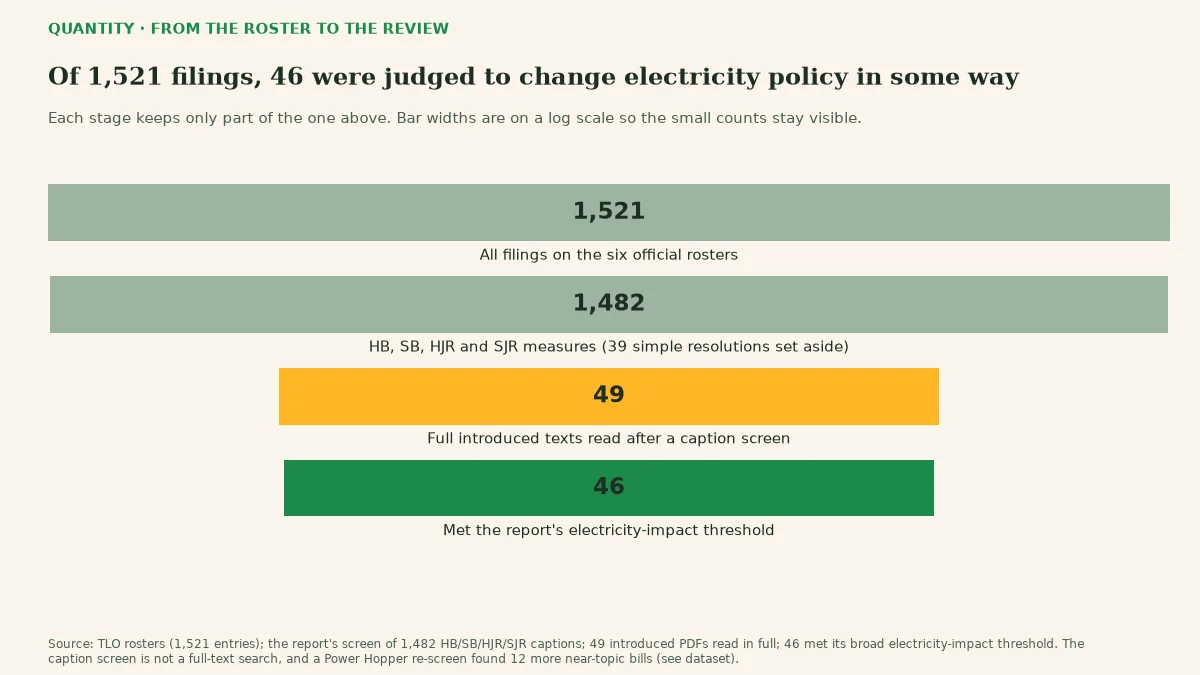
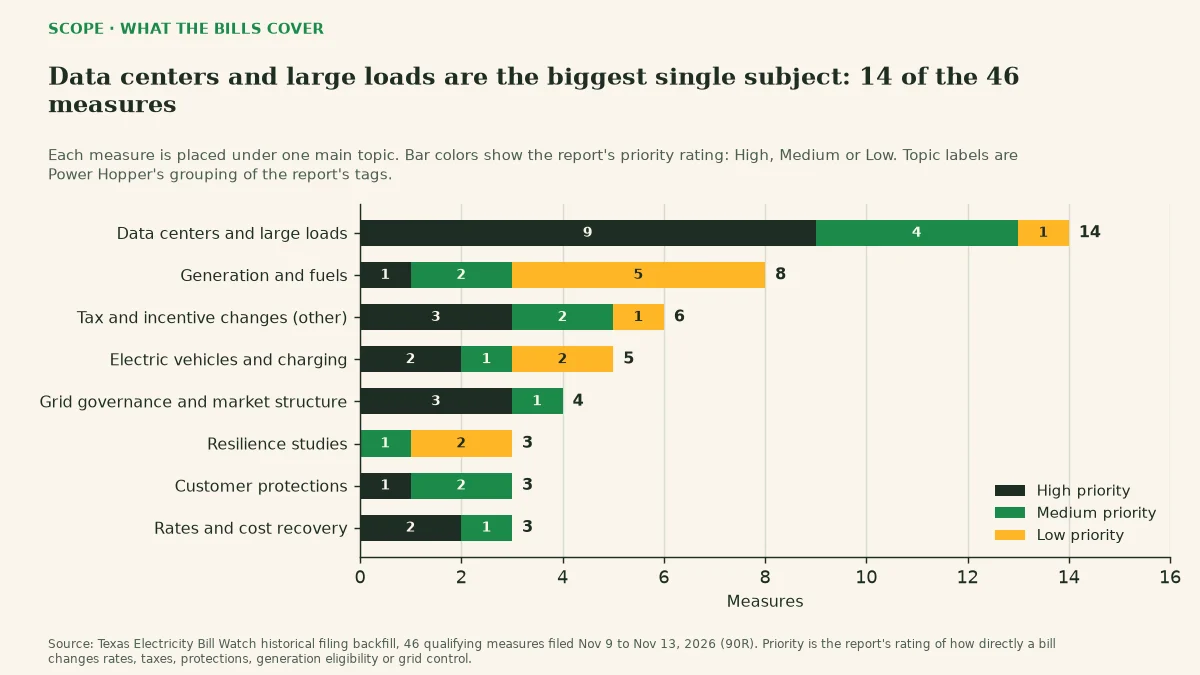
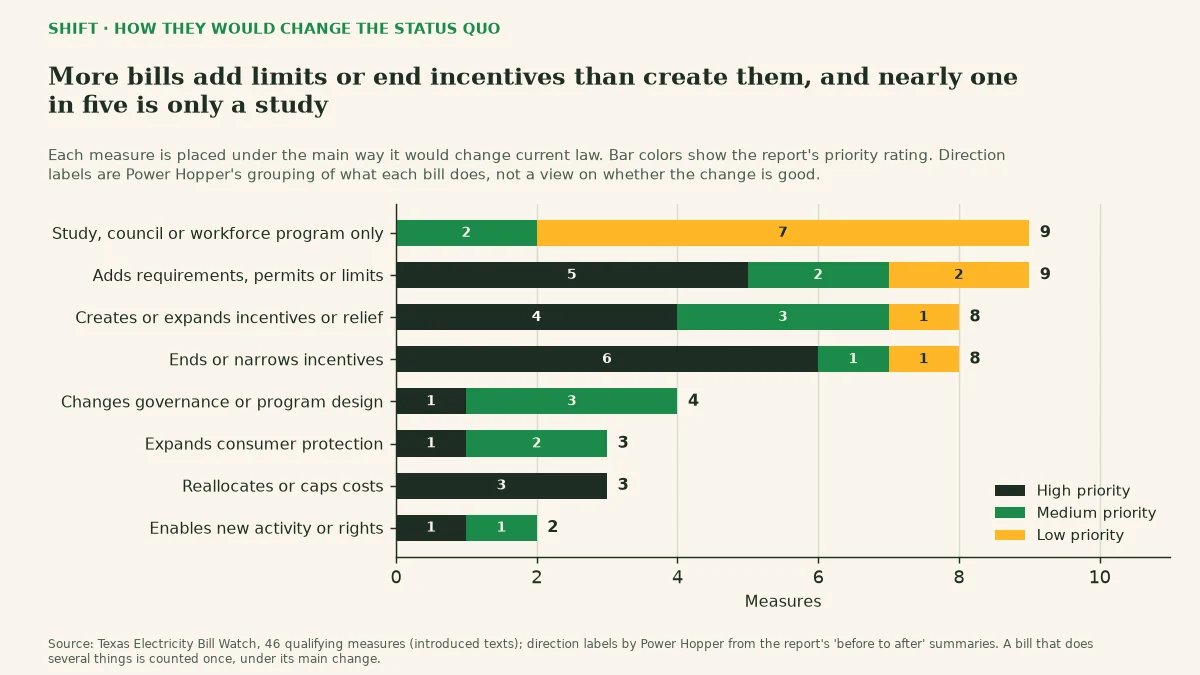
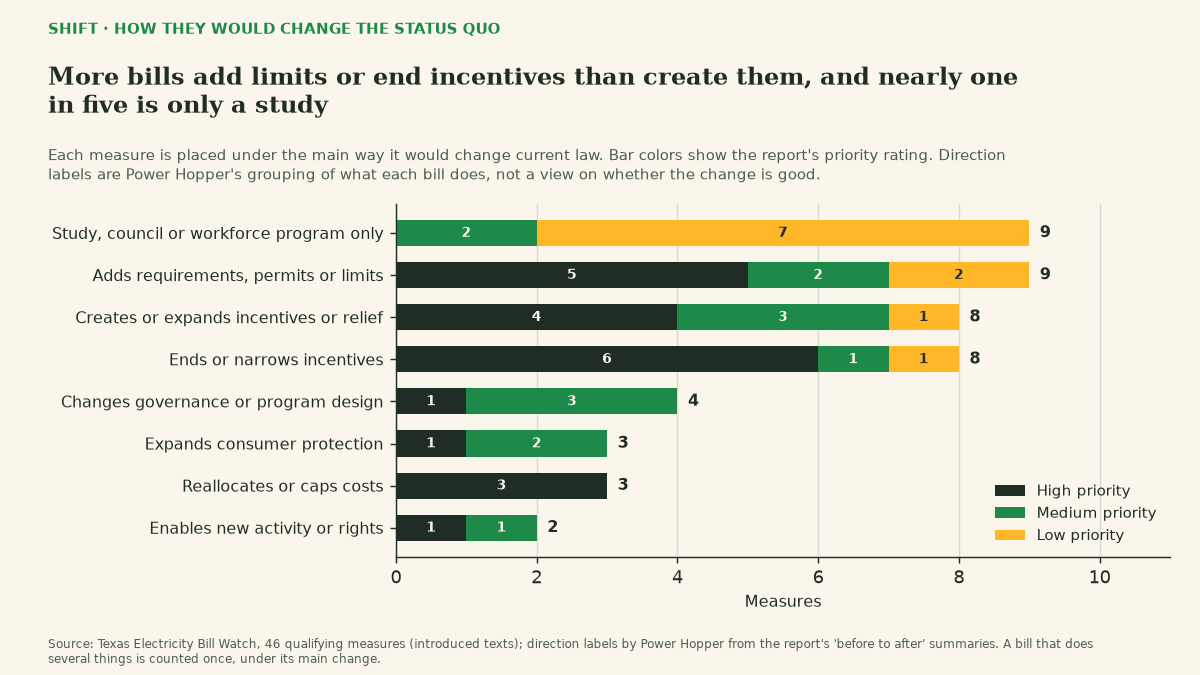
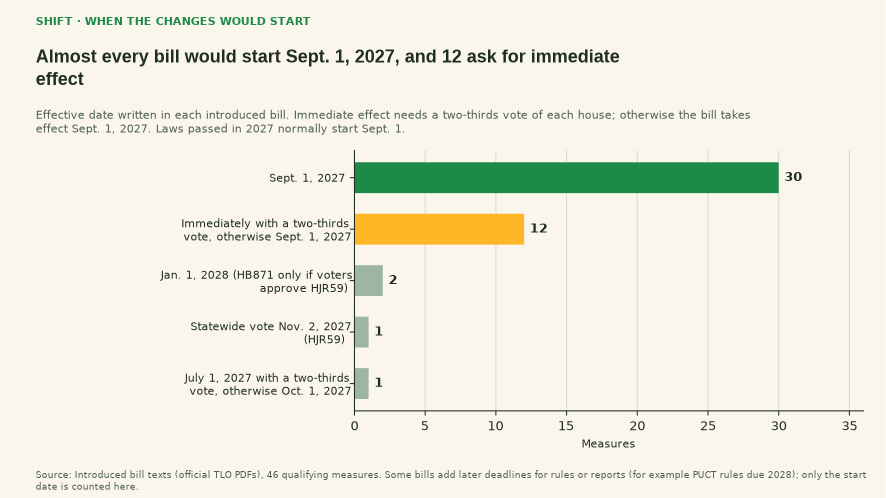
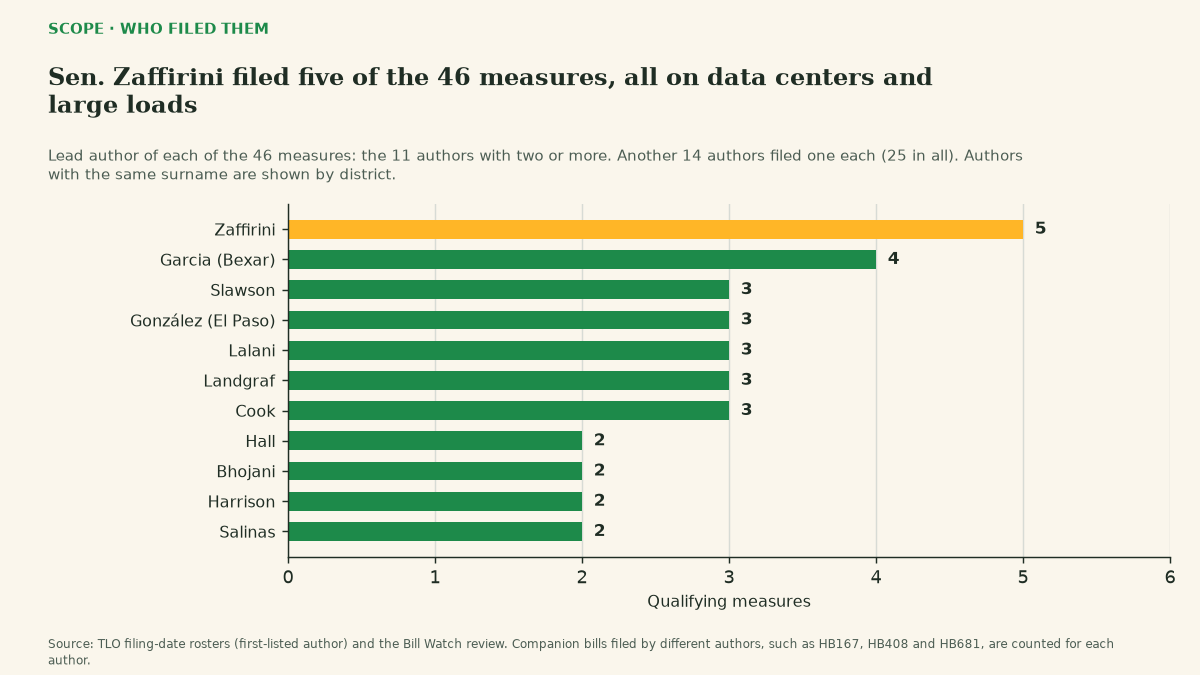
40 qualifying measures, ordered by practical importance. All measures below are proposed as filed, not enacted law.
HB1005
High priorityRates · Transmission
Author: Slawson · Filed: 2026-11-09 · Status: filed/prefiled · Original full text, official PDF · Official status/history
- What it does
- Requires full TDU-charge exemption or reimbursement for qualifying residential landowners adjoining newly built extra-high-voltage lines.
- Current status quo
- Ordinary residential TDU charges generally apply even when a line project acquires adjacent private property; no matching statewide rebate is identified.
- Before → after (governing change)
- Proposes 100% transmission-and-distribution charge exemption or semiannual reimbursement, transferable with land, until land-use conversion or Sept. 1, 2076. The draft labels the addition §309.2031 despite placing it in Chapter 39—an apparent citation error.
- How, who, when, and expected bill/renewable effect
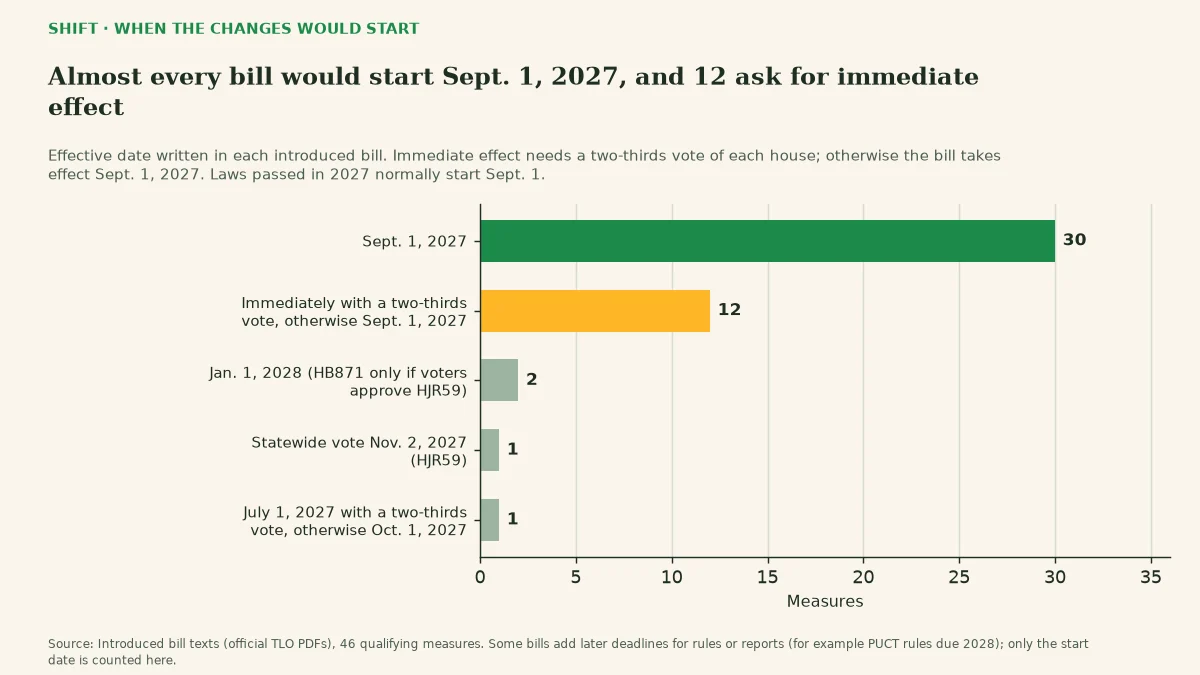
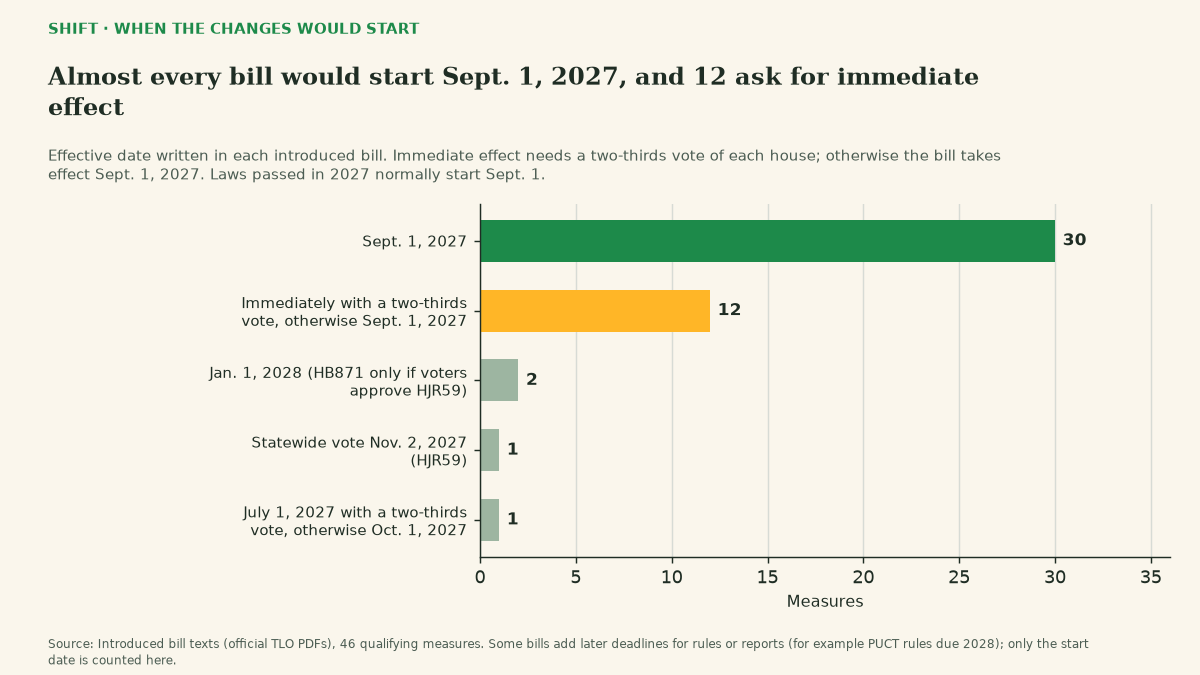
- Immediate with 2/3 vote or Sept. 1, 2027. Benefits directly affected homeowners and could shift utility revenue requirements to other ratepayers or owners; funding source unspecified. No special renewable-generation incentive.
Priority rationale: High because the measure directly changes rate recovery, tax incentives, customer protections, generation eligibility, or control of grid decisions.
HB139
High priorityRates · Utility structure
Author: González of El Paso · Filed: 2026-11-09 · Status: filed/prefiled · Original full text, official PDF · Official status/history
- What it does
- Creates a statutory ceiling on the nonfuel portion of residential rates charged by utilities solely outside ERCOT.
- Current status quo
- Under Chapter 36, PUCT/base-rate regulation applies without the five-year summer-peak nonfuel rate formula proposed here.
- Before → after (governing change)
- Adds §36.218: in a base-rate case, maximum nonfuel residential rate equals the inflation-adjusted average from prior five years at weather-adjusted summer peaks; interim revisions only for inflation or an unreasonable rate, with 30-day notice.
- How, who, when, and expected bill/renewable effect
- Effective Sept. 1, 2027; PUCT must establish process. Limits nonfuel rate-setting discretion in eligible monopoly territories, not ERCOT retail REP charges or fuel charges. Direction of bills depends on historical levels and utility cost evidence; possible under-recovery or later corrections.
Priority rationale: High because the measure directly changes rate recovery, tax incentives, customer protections, generation eligibility, or control of grid decisions.
HB167
High priorityLarge loads · Electricity taxes
Author: Martinez Fischer · Filed: 2026-11-09 · Status: filed/prefiled · Original full text, official PDF · Official status/history
- What it does
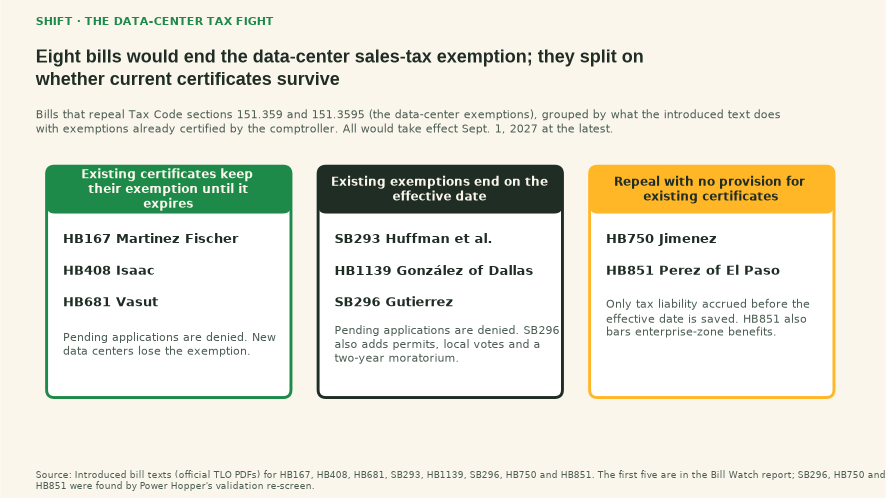
- Ends future data-center sales/use-tax exemptions, including qualified-center electricity-purchase relief, while protecting already certified exemptions.
- Current status quo
- Tax Code §§151.359/.3595 and §151.317(a)(9) currently exempt qualifying data-center tangible property and certain purchased electricity.
- Before → after (governing change)
- Repeals §§151.359/.3595 and removes data-center electricity from §151.317; existing certificates remain valid until their original exemption terms expire, pending applications denied.
- How, who, when, and expected bill/renewable effect
- Effective immediately with 2/3 vote or Sept. 1, 2027. Newer data centers face higher procurement/electricity tax burden; public tax revenue may rise, but household electric rates do not automatically fall. Same substantive language as HB408/HB681; unlike SB293/HB1139, grandfathering continues.
Priority rationale: High because the measure directly changes rate recovery, tax incentives, customer protections, generation eligibility, or control of grid decisions.
HB184
High priorityTransmission · Rates
Author: Slawson · Filed: 2026-11-09 · Status: filed/prefiled · Original full text, official PDF · Official status/history
- What it does
- Pauses PUCT approval of 765-kV lines until a grid-economics study receives independent review.
- Current status quo
- PUCT considers transmission approvals under existing certification and ERCOT planning processes; the mandatory special 765-kV study gate does not currently exist.
- Before → after (governing change)
- Adds §39.1671: examine dispatch scenarios, residential ratepayer costs, overruns, workforce/supply chain; independent reviewer cannot be an entity that recently studied extra-high-voltage lines for ERCOT or a market participant.
- How, who, when, and expected bill/renewable effect
- Immediate with 2/3 vote or Sept. 1, 2027; section expires Sept. 1, 2029. Could delay high-voltage projects and defer delivery charges, but also delay new wind/solar interconnections and reliability benefits. Net bill impact uncertain.
Priority rationale: High because the measure directly changes rate recovery, tax incentives, customer protections, generation eligibility, or control of grid decisions.
HB191
High priorityUtility structure · PUCT governance
Author: Slawson · Filed: 2026-11-09 · Status: filed/prefiled · Original full text, official PDF · Official status/history
- What it does
- Changes appointment and service terms of Texas utility commissioners and lengthens their lobbying restrictions.
- Current status quo
- §12.051 provides gubernatorial appointments with senate advice/consent and six-year staggered terms; §12.060 limits post-service lobbying.
- Before → after (governing change)
- Amends §§12.051/.060, adds §12.061: three-member governor/lieutenant-governor/speaker committee would select commissioners and leaders, set five-year terms, and increase former-commissioner lobbying restriction from one to three years.
- How, who, when, and expected bill/renewable effect
- Effective Sept. 1, 2027. Alters who governs all PUCT electric-rate and market decisions; rate and renewable outcomes depend on appointments and subsequent rulings, not specified in the bill.
Priority rationale: High because the measure directly changes rate recovery, tax incentives, customer protections, generation eligibility, or control of grid decisions.
HB284
High priorityDistributed generation · Tax incentives
Author: Money · Filed: 2026-11-09 · Status: filed/prefiled · Original full text, official PDF · Official status/history
- What it does
- Exempts certain behind-the-meter on-site distributed generation equipment, installations, use and leases from sales/use taxes.
- Current status quo
- Tax Code Chapter 151 imposes sales/use tax unless another exemption applies; there is not a general exemption in the form of proposed §151.3183 for qualifying exclusively on-site generation systems.
- Before → after (governing change)
- Adds §151.3183 covering necessary initial equipment for systems whose electricity is consumed solely at a nearby structure; excludes unrelated construction, repairs and maintenance.
- How, who, when, and expected bill/renewable effect
- Comptroller rules; July 1, 2027 with 2/3 vote, else Oct. 1, 2027. May reduce costs of self-supply solar or other distributed generators; exported power likely fails the “solely” consumed test. Public revenue falls; no guaranteed grid-rate change.
Priority rationale: High because the measure directly changes rate recovery, tax incentives, customer protections, generation eligibility, or control of grid decisions.
HB408
High priorityLarge loads · Electricity taxes
Author: Isaac · Filed: 2026-11-09 · Status: filed/prefiled · Original full text, official PDF · Official status/history
- What it does
- Removes future qualifying data-center sales/use-tax relief with grandfather protection.
- Current status quo
- Certified data centers presently qualify for exemption programs under Tax Code §§151.359/.3595, including electricity-use provisions in §151.317.
- Before → after (governing change)
- Repeals specified exemptions, preserves previously certified facilities until their remaining authorized terms expire and denies pending applications; text parallels HB167/HB681.
- How, who, when, and expected bill/renewable effect
- Immediate with 2/3 vote or Sept. 1, 2027. Raises costs for newly qualifying large loads without retroactively cancelling extant certificates; relative ratepayer effect indirect, renewable impact not specified.
Priority rationale: High because the measure directly changes rate recovery, tax incentives, customer protections, generation eligibility, or control of grid decisions.
HB589
High priorityGeneration incentives · ERCOT
Author: Lalani · Filed: 2026-11-09 · Status: filed/prefiled · Original full text, official PDF · Official status/history
- What it does
- Expressly treats geothermal, hydro, nuclear, gas, petroleum and coal generators as dispatchable for Texas Energy Fund financing.
- Current status quo
- Utilities Code §§34.0104/.0105 currently use a general controllable-output definition; electric energy storage remains disqualified from these loans and completion bonuses.
- Before → after (governing change)
- Adds §34.01015 and conforming edits to §§34.0104/.0105: enumerates eligible fuel/technology classes without changing the ≥100 MW loan threshold; storage remains excluded.
- How, who, when, and expected bill/renewable effect
- Effective Sept. 1, 2027. Could expand or clarify eligibility for geothermal/hydro and conventional generation; may shift subsidized generation mix, not promise lower retail rates. Wind/solar without dispatchability and batteries alone do not obtain these loans.
Priority rationale: High because the measure directly changes rate recovery, tax incentives, customer protections, generation eligibility, or control of grid decisions.
HB681
High priorityLarge loads · Electricity taxes
Author: Vasut · Filed: 2026-11-09 · Status: filed/prefiled · Original full text, official PDF · Official status/history
- What it does
- A third House filing proposing prospective repeal of data-center tax advantages.
- Current status quo
- The current §§151.359/.3595 exemption framework and §151.317(a)(9) lower certain certified data-center equipment and electricity taxes.
- Before → after (governing change)
- Repeals the exemptions but grandfathers existing certificates and denies applications still pending when effective; mirrors HB167/HB408.
- How, who, when, and expected bill/renewable effect
- Immediate with 2/3 vote or Sept. 1, 2027. New data-center customers can face higher tax-inclusive energy/plant bills, with no proven corresponding decrease in residential electricity rates.
Priority rationale: High because the measure directly changes rate recovery, tax incentives, customer protections, generation eligibility, or control of grid decisions.
HB730
High priorityRates · Large loads · Utility structure
Author: Perez of El Paso · Filed: 2026-11-09 · Status: filed/prefiled · Original full text, official PDF · Official status/history
- What it does
- Protects customers of non-ERCOT monopoly utilities from paying for generation built primarily for a single large load.
- Current status quo
- Under §36.053 ordinary prudent, used-and-useful generation investment can enter utility rate base; there is no proposal-specific prohibition on charging other customers for dedicated >75-MW generation.
- Before → after (governing change)
- Adds §36.053(e)-(g), §37.056(j) and §39.411: such investment cannot be recovered from others without prior PUCT findings of net benefit and cost-causation; qualifying interconnections face ≥$100,000 study fee, site-control proof and financial security.
- How, who, when, and expected bill/renewable effect
- Applies only to electric utilities solely outside ERCOT; PUCT interconnection rules due June 1, 2028; effective Sept. 1, 2027. Likely shifts speculative generation costs toward large-load sponsors and protects household rates, though safeguards may raise data-center development costs. Renewable connection is technology-neutral.
Priority rationale: High because the measure directly changes rate recovery, tax incentives, customer protections, generation eligibility, or control of grid decisions.
HB867
High priorityDistributed generation · EVs · ERCOT
Author: Anchía · Filed: 2026-11-09 · Status: filed/prefiled · Original full text, official PDF · Official status/history
- What it does
- Lets PUCT develop vehicle-to-grid standards and permit aggregators to sell energy from EV batteries into ERCOT.
- Current status quo
- Existing §39.916 distributed-generation framework does not establish the explicit vehicle-to-grid aggregation authorization in proposed §39.9161.
- Before → after (governing change)
- Adds §39.9161: PUCT may, not must, adopt technical interconnection standards and allow EV owners through aggregators/load-serving entities to participate in wholesale, ancillary and virtual-power-plant markets.
- How, who, when, and expected bill/renewable effect
- Effective Sept. 1, 2027. If implemented, EV owners could earn grid value, lower peak costs and support variable solar/wind; hardware, market rules and compensation are uncertain. Does not mandate a buyback rate.
Priority rationale: High because the measure directly changes rate recovery, tax incentives, customer protections, generation eligibility, or control of grid decisions.
SB191
High priorityTransmission · Utility structure
Author: Hall · Filed: 2026-11-09 · Status: filed/prefiled · Original full text, official PDF · Official status/history
- What it does
- Makes ERCOT-to-outside-region electric interconnection approvals more restrictive and procedural.
- Current status quo
- §37.051 already has a PUCT certificate/public-interest process for lines enabling imports or exports, with specific legacy exemptions.
- Before → after (governing change)
- Revises §37.051(c)-(c-4): forbids additional federal jurisdiction; PUCT public-interest findings after technical, cost and ERCOT reliability assessment; application at least 180 days before a FERC request, and separate post-FERC certificate.
- How, who, when, and expected bill/renewable effect
- Applies prospectively; immediate with 2/3 vote or Sept. 1, 2027. Could constrain regional power trading and cross-border renewable imports/exports while limiting federal-jurisdiction exposure; rate/reliability effect depends on foregone projects.
Priority rationale: High because the measure directly changes rate recovery, tax incentives, customer protections, generation eligibility, or control of grid decisions.
SB192
High priorityEVs · Renewable power
Author: Hall · Filed: 2026-11-09 · Status: filed/prefiled · Original full text, official PDF · Official status/history
- What it does
- Mandates on-site renewable electricity or renewable-priced electricity for regulated public EV charging equipment.
- Current status quo
- Occupations Code §2311.0301 currently requires equipment inspection and maintenance, without the proposed renewable-power source/pricing condition.
- Before → after (governing change)
- Adds §2311.0301(3), limits agency exemption authority, routes violation penalties to the highway fund and repeals Chapter 2311A.
- How, who, when, and expected bill/renewable effect
- Effective immediately with 2/3 vote or Sept. 1, 2027; charging providers must comply by Jan. 1, 2028. Could boost demand for green-priced supply/onsite generation and chargers’ procurement costs; wording does not clearly require matched renewable electrons.
Priority rationale: High because the measure directly changes rate recovery, tax incentives, customer protections, generation eligibility, or control of grid decisions.
SB287
High prioritySolar · Wind · Tax incentives
Author: Perry, Campbell · Filed: 2026-11-09 · Status: filed/prefiled · Original full text, official PDF · Official status/history
- What it does
- Repeals specified solar/wind and solar-industry franchise/property-tax preferences while preserving different protections.
- Current status quo
- Tax Code §11.27(a-1) exempts the appraised value of qualifying equipment even when the equipment owner does not own underlying real estate; §§171.056/171.107 give a solar-business franchise-tax exemption and solar-device cost deduction.
- Before → after (governing change)
- Repeals §11.27(a-1) and §§171.056/171.107 with transition protections; rewrites solar definitions in Local Government Code §229.101 and Property Code §202.010. It does not repeal the separate §11.27(a) property-value exemption.
- How, who, when, and expected bill/renewable effect
- Effective Jan. 1, 2028. Would increase tax exposure for certain third-party-owned solar/wind equipment and solar businesses; could weaken distributed renewable economics. Exact net costs depend on ownership and other exemptions.
Priority rationale: High because the measure directly changes rate recovery, tax incentives, customer protections, generation eligibility, or control of grid decisions.
SB293
High priorityLarge loads · Electricity taxes
Author: Huffman, et al. · Filed: 2026-11-09 · Status: filed/prefiled · Original full text, official PDF · Official status/history
- What it does
- Repeals qualifying data-center tax exemptions, including for electricity, without grandfathering already certified facilities.
- Current status quo
- Currently certified data centers can receive sales/use-tax exclusions for eligible property and electric power during specified certification periods.
- Before → after (governing change)
- Repeals §§151.359/.3595 and removes §151.317 data-center exemption; existing exemptions end on effective date and pending certification applications are rejected.
- How, who, when, and expected bill/renewable effect
- Immediate with 2/3 vote or Sept. 1, 2027. Higher tax exposure for both current and future qualifying data centers; material difference from HB167/HB408/HB681. Revenue shift may affect taxes but not ERCOT’s wholesale price mechanism.
Priority rationale: High because the measure directly changes rate recovery, tax incentives, customer protections, generation eligibility, or control of grid decisions.
SB32
High priorityLarge loads · Utility governance
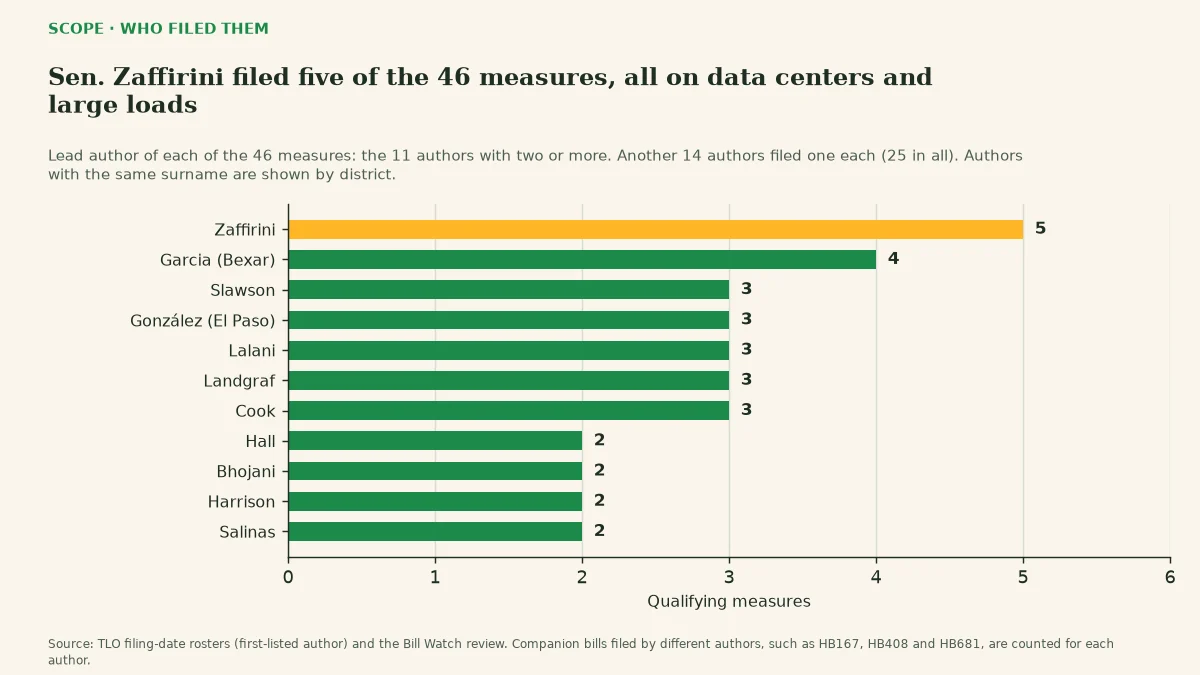
Author: Zaffirini · Filed: 2026-11-09 · Status: filed/prefiled · Original full text, official PDF · Official status/history
- What it does
- Creates a PUCT/TCEQ preconstruction permitting program for computational loads drawing at least 75 MW.
- Current status quo
- Large loads are already subject to specified electric interconnection planning/standards under Utilities Code §37.0561, but the new cross-agency site construction permit in proposed Title 7 does not yet exist.
- Before → after (governing change)
- Adds Utilities Code Title 7, Chapter 401: prior PUCT permit, disclosure of demand/energization and water impacts, reliability and environmental review, fees, possible denial/revocation and administrative penalties; applications confidential.
- How, who, when, and expected bill/renewable effect
- PUCT and TCEQ jointly adopt rules and memorandum of understanding; applies to construction beginning Sept. 1, 2027 or later. Could delay or condition high-demand projects and reduce poorly planned grid additions; effect on retail bills uncertain. No renewable-specific preference.
Priority rationale: High because the measure directly changes rate recovery, tax incentives, customer protections, generation eligibility, or control of grid decisions.
SB33
High priorityRates · Large loads
Author: Zaffirini · Filed: 2026-11-09 · Status: filed/prefiled · Original full text, official PDF · Official status/history
- What it does
- Separates the transmission costs attributable to data centers, AI and crypto computation from ordinary electric customers.
- Current status quo
- Utilities Code §35.004(c-1)/(c-2) requires qualifying large loads to contribute to interconnection costs, but does not establish the dedicated computational-site transmission rate class this bill proposes.
- Before → after (governing change)
- Redesignates those duties as §35.0041(a)-(b) and adds (c)-(f): PUCT must allocate otherwise unrecovered computational-load transmission costs to their own class and may require demand charges and contractual commitments.
- How, who, when, and expected bill/renewable effect
- PUCT rules by Sept. 1, 2028; customers at computational sites pay more cost-caused charges, reducing the risk that households and other businesses subsidize dedicated upgrades. Actual retail bill savings depend on tariff design and approved projects; renewable effect indirect through transmission cost allocation. Effective immediately with 2/3 vote, otherwise Sept. 1, 2027.
Priority rationale: High because the measure directly changes rate recovery, tax incentives, customer protections, generation eligibility, or control of grid decisions.
SB34
High priorityLarge loads · Utility governance
Author: Zaffirini · Filed: 2026-11-09 · Status: filed/prefiled · Original full text, official PDF · Official status/history
- What it does
- Gives counties new zoning and special-use authority over large computational sites in unincorporated territory.
- Current status quo
- Texas counties generally lack the broad purpose-specific computational-load zoning and permitting power described in this proposed Local Government Code chapter.
- Before → after (governing change)
- Adds §§231.301-.310: county zoning districts, location/noise/water/road conditions, financial assurances, electric-demand documentation, permits, stop-work orders and penalties; expressly disallows regulating electric rates, ERCOT or transmission siting.
- How, who, when, and expected bill/renewable effect
- County commissioners administer it from Sept. 1, 2027. May reduce local infrastructure burdens but lengthen data-center approval and affect when new electric demand appears; not a direct rate cap. Draft text contains inconsistent subsection lettering; implementation would need care.
Priority rationale: High because the measure directly changes rate recovery, tax incentives, customer protections, generation eligibility, or control of grid decisions.
HB108
Medium priorityUtility structure · Customer choice
Author: González of El Paso · Filed: 2026-11-09 · Status: filed/prefiled · Original full text, official PDF · Official status/history
- What it does
- Directs PUCT to study a large vertically integrated monopoly electric-service territory outside ERCOT and potential retail customer choice.
- Current status quo
- Eligible non-ERCOT territory retains generation/transmission/distribution monopoly service; §31.002 defines customer choice but the bill does not itself authorize retail competition there.
- Before → after (governing change)
- Requires ratepayer/market study and recommendations for introducing customer choice; report due Dec. 31, 2028; study expires Jan. 1, 2029.
- How, who, when, and expected bill/renewable effect
- Effective Sept. 1, 2027. This is a study, not deregulation; possible future effects on monopoly rates, supplier entry and renewable procurement only if later enacted. Customers would see no immediate retail-choice change.
Priority rationale: Medium because the measure affects a material electric-market segment or project approval but has uncertain statewide consumer-bill consequences.
HB116
Medium priorityRates · Municipal utilities
Author: González of El Paso · Filed: 2026-11-09 · Status: filed/prefiled · Original full text, official PDF · Official status/history
- What it does
- Extends higher-education-style electric discounts to eligible school districts and taxing political subdivisions in a qualifying border county.
- Current status quo
- Utilities Code §36.351 requires specified higher-education electric-service discounts; the proposed additional border-county public-school/political-subdivision class is not generally included.
- Before → after (governing change)
- Adds §36.3511: matching discounts from electric and municipal utilities, exempt if the discount exceeds 1% of annual utility revenue; bars shifting designated costs to residential/other customer classes.
- How, who, when, and expected bill/renewable effect
- Effective Sept. 1, 2027, excluding preexisting contracts. Benefits covered public facilities and taxpayers; utilities must file tariffs, while cost recovery restriction may affect utility margins. No direct solar/wind preference.
Priority rationale: Medium because the measure affects a material electric-market segment or project approval but has uncertain statewide consumer-bill consequences.
HB514
Medium priorityWind · Property rights
Author: Garcia of Bexar · Filed: 2026-11-09 · Status: filed/prefiled · Original full text, official PDF · Official status/history
- What it does
- Clarifies the surface owner’s right to use wind and the procedures for clearing expired wind-project agreements from property records.
- Current status quo
- Wind leases operate under property/contract law; the comprehensive wind-specific Chapter 304 proposed here does not exist.
- Before → after (governing change)
- Adds Chapter 304: nonseverable surface-estate right to capture wind; developer must record release of expired/terminated agreements, with 90-day response process after owner request.
- How, who, when, and expected bill/renewable effect
- Effective Sept. 1, 2027; existing agreements remain valid. Could lower land-title barriers for new wind development, benefiting landowners/developers; no fixed electric-rate effect.
Priority rationale: Medium because the measure affects a material electric-market segment or project approval but has uncertain statewide consumer-bill consequences.
HB547
Medium priorityLarge loads · Local permitting
Author: Bhojani · Filed: 2026-11-09 · Status: filed/prefiled · Original full text, official PDF · Official status/history
- What it does
- Allows counties to enforce acoustic limits for qualifying large-load electric sites.
- Current status quo
- Existing large-load interconnection rules do not independently create the proposed county noise-study and site approval procedure.
- Before → after (governing change)
- Adds Utilities Code §37.0562 and Local Government Code §§233.171-.178: optional county siting approvals, pre/post-construction engineer noise studies and limits of 55–70 dB(A) by neighboring land use.
- How, who, when, and expected bill/renewable effect
- Effective Sept. 1, 2027 for new permit applications. Could raise project mitigation costs or delay data centers; does not let counties set electric rates or interconnection standards. Rate and renewable impacts secondary.
Priority rationale: Medium because the measure affects a material electric-market segment or project approval but has uncertain statewide consumer-bill consequences.
HB821
Medium priorityGeneration · State governance
Author: Harrison · Filed: 2026-11-09 · Status: filed/prefiled · Original full text, official PDF · Official status/history
- What it does
- Abolishes the Texas Advanced Nuclear Energy Office.
- Current status quo
- Government Code Chapter 483, created in 2025, organizes the state’s nuclear-energy development office.
- Before → after (governing change)
- Repeals Chapter 483 and directs appropriated office funding to the Texas Education Agency to reduce school tax-rate compression.
- How, who, when, and expected bill/renewable effect
- Immediate with 2/3 vote or Sept. 1, 2027. Could reduce organized state support for new nuclear capacity; property-tax and long-run power-price results indirect and uncertain. Nuclear is low-carbon but not wind/solar renewable.
Priority rationale: Medium because the measure affects a material electric-market segment or project approval but has uncertain statewide consumer-bill consequences.
HB871
Medium priorityDistributed generation · Property tax
Author: Landgraf · Filed: 2026-11-09 · Status: filed/prefiled · Original full text, official PDF · Official status/history
- What it does
- Establishes a property-value tax exemption for some fuel-powered on-site backup generators, conditional on a voter-approved constitutional amendment.
- Current status quo
- Property-tax code already exempts qualifying solar/wind devices under §11.27, but not all specified natural-gas, diesel, biodiesel, hydrogen or propane enclosed transfer-switch generators.
- Before → after (governing change)
- Adds Tax Code §11.39 and extends exemption procedure in §11.43 for the added value of eligible generators; only takes effect if companion HJR59 wins voters’ approval.
- How, who, when, and expected bill/renewable effect
- Potential effective Jan. 1, 2028. May encourage backup generation and resilience but reduce property-tax receipts; primarily favors fuel-based units rather than wind/solar, with no direct retail-rate reduction.
Priority rationale: Medium because the measure affects a material electric-market segment or project approval but has uncertain statewide consumer-bill consequences.
HB928
Medium priorityLarge loads · Local permitting
Author: Mizani · Filed: 2026-11-09 · Status: filed/prefiled · Original full text, official PDF · Official status/history
- What it does
- Requires affirmative city or county public-hearing approval before constructing any data center.
- Current status quo
- No statewide rule generally conditions construction of all data centers on a dedicated approval vote of this type.
- Before → after (governing change)
- Adds §250.015: municipality must approve facilities inside city limits; county commissioners must approve facilities in unincorporated territory.
- How, who, when, and expected bill/renewable effect
- Effective Sept. 1, 2027 for projects with new initial permit applications. Broad siting veto may slow new large electricity demand; no direct TDU rates or renewable policy changes.
Priority rationale: Medium because the measure affects a material electric-market segment or project approval but has uncertain statewide consumer-bill consequences.
HJR59
Medium priorityDistributed generation · Constitution
Author: Landgraf · Filed: 2026-11-09 · Status: filed/prefiled · Original full text, official PDF · Official status/history
- What it does
- Proposes the constitutional permission needed for HB871’s on-site generator tax exemption.
- Current status quo
- Article VIII §2(a) explicitly authorizes solar/wind-powered device exemptions; fuel-powered backup generator additions are not expressly listed there.
- Before → after (governing change)
- Amends Article VIII §2(a) to authorize the Legislature to exempt property value attributable to on-site electric generators; statewide vote Nov. 2, 2027.
- How, who, when, and expected bill/renewable effect
- Requires voter approval and separate implementing law such as HB871 to grant relief; could favor on-site backup power, modestly alter property taxes, but does not itself create a consumer electricity discount.
Priority rationale: Medium because the measure affects a material electric-market segment or project approval but has uncertain statewide consumer-bill consequences.
SB224
Medium priorityCustomer protections · Rates
Author: West · Filed: 2026-11-09 · Status: filed/prefiled · Original full text, official PDF · Official status/history
- What it does
- Requires landlords of submetered apartment properties to warn tenants about utility cutoff caused by the landlord’s unpaid bill.
- Current status quo
- Property Code §92.301 gives tenant remedies for loss of utilities; proposed §92.303 would add a specific five-day notice and prohibited-fee rule.
- Before → after (governing change)
- Adds §92.303: mail/hand-deliver notice within five days of provider disconnection notice, including prescribed English/Spanish language; landlord may not pass through late/disconnect/reconnect charges.
- How, who, when, and expected bill/renewable effect
- Effective Sept. 1, 2027 for future notices. Protects multifamily tenants (including electricity customers) from surprise loss and pass-through penalties; could shift such costs to landlords, not a statewide kWh rate change.
Priority rationale: Medium because the measure affects a material electric-market segment or project approval but has uncertain statewide consumer-bill consequences.
SB240
Medium priorityCustomer protections · Reliability
Author: Cook of Harris, et al. · Filed: 2026-11-09 · Status: filed/prefiled · Original full text, official PDF · Official status/history
- What it does
- Expands critical-care residential electric customer classification to people dependent on an elevator to enter/exit home.
- Current status quo
- §17.002(3-a) currently covers physician-diagnosed life-sustaining electrically powered medical devices only.
- Before → after (governing change)
- Adds physician-diagnosed dependence on a home-access elevator as an alternative qualification for critical-care residential designation.
- How, who, when, and expected bill/renewable effect
- Immediate with 2/3 vote or Sept. 1, 2027. Extends outage and disconnection accommodations to more households; no specified tariff or renewable change, potential administrative costs uncertain.
Priority rationale: Medium because the measure affects a material electric-market segment or project approval but has uncertain statewide consumer-bill consequences.
SB35
Medium priorityLarge loads · ERCOT governance
Author: Zaffirini · Filed: 2026-11-09 · Status: filed/prefiled · Original full text, official PDF · Official status/history
- What it does
- Requires ERCOT to provide large-electric-load information to the Texas Water Development Board.
- Current status quo
- ERCOT handles large-load interconnection data, but the specified statutory transmission of that information to TWDB for water planning is new.
- Before → after (governing change)
- Adds §39.920: PUCT directs ERCOT to share §37.0561 large-load customer information as necessary for water planning; shared data becomes confidential.
- How, who, when, and expected bill/renewable effect
- Effective Sept. 1, 2027. Helps water-grid planning for data centers, with no immediate tariff or renewable requirement; planning costs and benefits not quantifiable.
Priority rationale: Medium because the measure affects a material electric-market segment or project approval but has uncertain statewide consumer-bill consequences.
SB36
Medium priorityRates · Large-load incentives
Author: Zaffirini · Filed: 2026-11-09 · Status: filed/prefiled · Original full text, official PDF · Official status/history
- What it does
- Restricts data-center use of overlapping state and local tax incentives.
- Current status quo
- Qualifying data centers may have sales-tax exemptions under Tax Code §§151.359/.3595 and separate local economic-development or property-tax incentives subject to current eligibility rules.
- Before → after (governing change)
- Adds Local Government Code §§380.005/381.006, Tax Code §312.0022; bans new/renewed municipal or county development agreements and new property-tax abatements for registered centers; tightens concurrent state sales-tax exemption eligibility.
- How, who, when, and expected bill/renewable effect
- Effective Sept. 1, 2027; new agreements/applications only. May increase data-center taxes and local government revenue while reducing development subsidies; it does not directly impose new TDU rate classes or guarantee ratepayer savings.
Priority rationale: Medium because the measure affects a material electric-market segment or project approval but has uncertain statewide consumer-bill consequences.
HB166
Low priorityEVs · Alternative-fuel grants
Author: Cortez · Filed: 2026-11-09 · Status: filed/prefiled · Original full text, official PDF · Official status/history
- What it does
- Adjusts priority in an alternative-fueling-facility grant program, potentially including electric charging.
- Current status quo
- Health and Safety Code §393.004(b) prioritizes publicly accessible eligible stations when awarding grants.
- Before → after (governing change)
- Exempts qualifying transit-authority facilities in populous nonattainment/affected counties from the public-access priority restriction.
- How, who, when, and expected bill/renewable effect
- Effective Sept. 1, 2027 for later grant rounds. Could improve grant access for transit fueling/charging sites, but effects on private renewable generation or residential rates are minimal; note HB1144 separately proposes replacing Chapter 393.
Priority rationale: Low because the measure primarily funds studies, planning, workforce, or localized charging/incentive changes.
HB329
Low priorityGeothermal · Generation policy
Author: Garcia of Bexar · Filed: 2026-11-09 · Status: filed/prefiled · Original full text, official PDF · Official status/history
- What it does
- Creates a state geothermal-development policy council in the Railroad Commission.
- Current status quo
- Natural Resources Code Chapter 81 does not provide the new council with this specific membership and planning remit.
- Before → after (governing change)
- Adds §81.076: Railroad Commission-led council studies industry development, tax incentives and geothermal oversight and recommends legislation; expires Jan. 1, 2034.
- How, who, when, and expected bill/renewable effect
- Effective Sept. 1, 2027. Could support future geothermal-electricity projects, but creates no direct permit reform, incentive payment or customer rate change. Substantively duplicated by HB994.
Priority rationale: Low because the measure primarily funds studies, planning, workforce, or localized charging/incentive changes.
HB349
Low priorityGeothermal · Workforce
Author: Garcia of Bexar · Filed: 2026-11-09 · Status: filed/prefiled · Original full text, official PDF · Official status/history
- What it does
- Creates statewide geothermal workforce education and training work.
- Current status quo
- Labor Code §302.0085 geothermal-specific Texas Workforce Commission initiative does not presently exist.
- Before → after (governing change)
- Adds §302.0085 directing curriculum, funding opportunities, education-industry partnerships and annual legislative reports.
- How, who, when, and expected bill/renewable effect
- Effective Sept. 1, 2027. Could ease future geothermal labor constraints, with indirect and uncertain effects on renewable power costs and electric bills. Same substantive proposal as HB993.
Priority rationale: Low because the measure primarily funds studies, planning, workforce, or localized charging/incentive changes.
HB502
Low priorityGeothermal · Generation study
Author: Garcia of Bexar · Filed: 2026-11-09 · Status: filed/prefiled · Original full text, official PDF · Official status/history
- What it does
- Studies using abandoned and inactive Bexar County oil/gas wells for geothermal production, including electricity.
- Current status quo
- Railroad Commission regulates wells and abandonment; this one-time site-specific conversion study is not currently mandated.
- Before → after (governing change)
- Requires well inventory, geologic/cost analysis, electrical and heat applications, barriers and possible pilot-program recommendations; report due Dec. 1, 2028; expires Jan. 1, 2029.
- How, who, when, and expected bill/renewable effect
- Effective Sept. 1, 2027. No direct well conversion required or rates altered; could identify new small geothermal generation options later.
Priority rationale: Low because the measure primarily funds studies, planning, workforce, or localized charging/incentive changes.
HB595
Low priorityDistribution · Resilience study
Author: Lalani · Filed: 2026-11-09 · Status: filed/prefiled · Original full text, official PDF · Official status/history
- What it does
- Requires an economics and resilience study of undergrounding power lines within 150 miles of the Gulf Coast.
- Current status quo
- PUCT oversees electric reliability but has no mandate for the exact temporary Gulf Coast study proposed here.
- Before → after (governing change)
- Requires cost, maintenance, outage-savings, technology and environmental feasibility assessments; report by Sept. 1, 2028, sunset Oct. 31, 2028.
- How, who, when, and expected bill/renewable effect
- Effective Sept. 1, 2027. No immediate underground construction or delivery-charge increase; future investment could improve storm resilience but entail large capital recovery. Similar, not identical, to HB601.
Priority rationale: Low because the measure primarily funds studies, planning, workforce, or localized charging/incentive changes.
HB601
Low priorityDistribution · Resilience study
Author: Lalani · Filed: 2026-11-09 · Status: filed/prefiled · Original full text, official PDF · Official status/history
- What it does
- Companion-like Gulf Coast buried-power-line cost study with a narrower scope than HB595.
- Current status quo
- There is no targeted statewide PUCT report requirement for this Gulf Coast region.
- Before → after (governing change)
- Requires cost, maintenance, outage-savings and federal technology analysis; omits HB595’s separate environmental feasibility assessment.
- How, who, when, and expected bill/renewable effect
- Effective Sept. 1, 2027; report by Sept. 1, 2028, sunset Oct. 31, 2028. Informational only; bill effects and renewable-interconnection implications await future construction decisions.
Priority rationale: Low because the measure primarily funds studies, planning, workforce, or localized charging/incentive changes.
HB706
Low priorityLarge loads · Local incentives
Author: Ochoa · Filed: 2026-11-09 · Status: filed/prefiled · Original full text, official PDF · Official status/history
- What it does
- Requires elections and extensive public hearings before certain municipal data-center development incentives.
- Current status quo
- Local Government Code Chapter 380 authorizes qualifying municipal economic-development agreements without this data-center-specific ballot requirement.
- Before → after (governing change)
- Adds §380.005: five public hearings and voter approval before a covered data-center development agreement, including inviting utility departments and REPs to hearings.
- How, who, when, and expected bill/renewable effect
- Effective Sept. 1, 2027 for new agreements. Could slow subsidized data-center growth and electricity demand but leaves grid tariffs, rate recovery and renewable rules untouched.
Priority rationale: Low because the measure primarily funds studies, planning, workforce, or localized charging/incentive changes.
HB829
Low priorityGeneration · Industrial incentives
Author: Harrison · Filed: 2026-11-09 · Status: filed/prefiled · Original full text, official PDF · Official status/history
- What it does
- Repeals the Texas Jobs, Energy, Technology, and Innovation Act tax-value limitation program.
- Current status quo
- Government Code Chapter 403 Subchapter T provides school district taxable-value limitations for qualifying large investments, with prior agreements protected.
- Before → after (governing change)
- Repeals the program for new projects, retains existing agreements and makes conforming Education/Tax/Government Code edits.
- How, who, when, and expected bill/renewable effect
- Effective Sept. 1, 2027. Could increase property-tax burden for future qualifying industrial/energy investments and alter the generation investment pipeline; not a direct consumer electricity rate rule. Renewable project eligibility must be assessed separately, not assumed.
Priority rationale: Low because the measure primarily funds studies, planning, workforce, or localized charging/incentive changes.
HB993
Low priorityGeothermal · Workforce
Author: Salinas · Filed: 2026-11-09 · Status: filed/prefiled · Original full text, official PDF · Official status/history
- What it does
- Companion-like second filing for a geothermal workforce program.
- Current status quo
- General workforce-development tools exist, but not the geothermal-specific initiative in new §302.0085.
- Before → after (governing change)
- Creates Texas Workforce Commission geothermal curriculum, partnership and annual-report duties; mirrors HB349.
- How, who, when, and expected bill/renewable effect
- Effective Sept. 1, 2027. Potential long-term labor benefit to renewable geothermal developers, no immediate household tariff effect.
Priority rationale: Low because the measure primarily funds studies, planning, workforce, or localized charging/incentive changes.
HB994
Low priorityGeothermal · Generation policy
Author: Salinas · Filed: 2026-11-09 · Status: filed/prefiled · Original full text, official PDF · Official status/history
- What it does
- Separately files the same geothermal policy-council proposal as HB329.
- Current status quo
- No Chapter 81 council currently has this exact statutory geothermal industry development and regulator-planning mission.
- Before → after (governing change)
- Adds §81.076 with Railroad Commission council, analysis of tax incentives, oversight plan and reports; sunsets Jan. 1, 2034.
- How, who, when, and expected bill/renewable effect
- Effective Sept. 1, 2027. Only future indirect possibilities for dispatchable renewable development and rates; grouped with HB329, not silently dropped.
Priority rationale: Low because the measure primarily funds studies, planning, workforce, or localized charging/incentive changes.