Legislation · 90th Legislature prefiling · Source-checked

Texas Electricity Bill Watch: 90th Legislature Filings, Nov 20, 2026

On Nov. 20, 2026, Texas lawmakers filed 35 measures for the 2027 session. Five touch the grid or data centers: a two-year pause and new permits for large data centers, limits on eminent domain for power lines, cleanup money for wind, solar and battery projects, and two data-center tax and disclosure rules. Here is what they would do, in plain English, and the full list. Nothing here is law.

By Power Hopper Team · Research prepared and source-checked November 22, 2026

Download CSV Download JSON

What happened

On Friday, Nov. 20, Texas lawmakers filed 35 more measures for the legislative session that starts in January 2027. Five touch data centers, power plants or power lines. HB1273 would pause new large data centers for two years, then require a local vote, a state permit and yearly payments to county residents. HB1261 would add new limits on taking land by eminent domain, including for transmission lines, but only if voters approve a constitutional amendment. SB461 would make wind, solar and battery projects set aside cleanup money when the lease begins. HB1271 would end the sales-tax break for new data centers, and HB1272 would require local incentive deals with data centers to be published in full. The other 30 are about schools, courts, health, taxes and other subjects.

35measures filed Nov 20
5touch data centers, power plants or power lines
10bill texts read (76 pages)
0are law

Filed is not passed. A bill filed now still has to clear committees, both the House and Senate and the governor. This page follows the Bill Watch for Nov. 19.

The bills, in plain English

HB1273 · A two-year pause on new large data centers, then local votes, a state permit and yearly payments to residents

Could affect the gridCastellano · Filed Nov 20, 2026; not law · Bill text (PDF)

What the law says now
Texas has no state permit or local vote for data centers. The Public Utility Commission (PUC) sets standards for connecting large power users in ERCOT (Utilities Code §37.0561). Data centers certified by the Comptroller can skip state and local sales tax, including on the electricity they use (Tax Code §§151.317, 151.359 and 151.3595).
What would change
Covers data centers designed to use 20 megawatts or more, or with 50,000 square feet or more of computer space; an expansion of 10 MW or 25,000 square feet counts as a new project, and related sites within two miles count as one. For two years, no agency or city could approve a covered project and no utility could switch on new or bigger service for one. Data centers already running could keep operating at their approved size. After that, a project would need a majority vote in the county (and in the city, if it is inside one) and a new data center impact permit from the Texas Commission on Environmental Quality (TCEQ), with written findings from the PUC on reliability and costs and from the Texas Water Development Board on water. The developer would have to show it will pay the extra grid costs it causes, without shifting them to residential customers. Each year the operator would pay county residents, in equal shares, the larger of 2% of the center's gross receipts or $10,000 per megawatt of its approved demand. The bill ends the data-center sales-tax exemptions, including ones already granted, when it takes effect. Violations could cost up to $25,000 a day.
When
Takes effect immediately with a two-thirds vote of all members in each chamber, otherwise Sept. 1, 2027. The pause ends two years after that. State rules are due by March 1, 2028. The yearly resident payments apply to projects first permitted under the new law.
What it could mean for electricity
Could hold back new very large power users in Texas for at least two years. The bill says data centers, not households, must pay the added grid costs they cause. Whether household bills go up or down depends on how much new demand and grid building it prevents, which the bill does not estimate.

HB1261 · New limits on taking land by eminent domain, including for power lines

Could affect the gridSpencer · Filed Nov 20, 2026; not law · Bill text (PDF)

What the law says now
Electric and gas companies may condemn land they need (Utilities Code §181.004). Government Code chapter 2206 and Property Code chapter 21 set the process, and owners are paid fair market value.
What would change
Every condemnation under state law, including for utilities, transmission lines and pipelines, would face new steps before a case is filed: proof by clear and convincing evidence that the exact parcel is indispensable and that no feasible alternative exists; review by an independent three-member panel the district court appoints; full disclosure and a public hearing in each county at least 90 days before filing; and a court ruling on necessity before the condemnor can take possession. A project taking more than 100 acres, or land from more than 10 owners, would need a majority vote in every affected county. Farmland, ranches held by one family for 25 years, homesteads and similar protected land would need a two-thirds vote. Owners would get at least 200% of fair market value, could buy the land back if it is not used for the stated purpose within 10 years, and would share revenue earned directly from the land. Private for-profit companies and unelected boards could not receive any new grant of condemnation power, and only the state or an elected local body could authorize a taking.
When
Takes effect Jan. 1, 2028, but only if Texas voters approve a constitutional amendment on public necessity at the Nov. 2, 2027 election. No joint resolution proposing that amendment was filed on Nov. 20. It would apply to condemnation cases filed on or after the effective date.
What it could mean for electricity
Could slow new transmission lines or raise their cost, because most lines need easements from many landowners. Line costs are usually recovered from customers through delivery charges, so bills could rise if routes cost more; the bill gives no estimate. New lines are also how new power plants reach cities.

SB461 · Cleanup money for wind, solar and battery projects, due when the lease begins

Could affect the gridHall · Filed Nov 20, 2026; not law · Bill text (PDF)

What the law says now
Leases for wind, solar and battery projects must make the company responsible for removing them and must secure that with financial assurance for the landowner (Utilities Code chapters 301 to 303). The money can be delivered as late as the 10th (wind), 15th (battery) or 20th (solar) year of operation, goes to the landowner, and can be a parent-company guarantee, a letter of credit or a bond.
What would change
The financial assurance, still payable to the landowner, would be delivered to TCEQ when the lease begins. Parent-company guarantees and letters of credit are no longer listed; a bond or another form the landowner accepts remains. Battery projects would also have to cover damage from fires, chemical leaks, explosions and similar failures, or carry insurance naming the landowner. The same rules would extend to other renewable plants (such as geothermal or biomass) and other storage that sell power at wholesale. TCEQ would inspect the site and decide whether to release the money to the company or forfeit it to the landowner. A company whose assurance is forfeited could not get new or renewed permits for these facilities from TCEQ or the PUC.
When
Takes effect immediately with a two-thirds vote, otherwise Sept. 1, 2027. It applies to leases signed after that date, but projects with older leases would have to deliver the money to TCEQ by the earlier of a lease amendment or Jan. 1, 2028.
What it could mean for electricity
Indirect. Setting the money aside years earlier raises the up-front cost of new wind, solar and battery projects, which could make some harder to finance. It does not change rates. Landowners gain protection if a project is abandoned.

HB1271 · Ending the sales-tax break for new data centers

Smaller changeCastellano · Filed Nov 20, 2026; not law · Bill text (PDF)

What the law says now
Data centers certified by the Comptroller can buy equipment and electricity without paying state and local sales tax (Tax Code §§151.317, 151.359 and 151.3595).
What would change
Repeals both data-center exemptions, the electricity exemption tied to them and Tax Code §313.009. Data centers certified before the bill takes effect keep the break until their exemption period ends. Pending applications are denied.
When
Takes effect immediately with a two-thirds vote, otherwise Sept. 1, 2027. HB1273 contains the same repeal but would also end exemptions already granted.
What it could mean for electricity
Future data centers would pay sales tax on the electricity they buy unless another exemption applies, which raises their cost of power. Household rates do not change directly.

HB1272 · Publishing local incentive deals with data centers in full

Smaller changeCastellano · Filed Nov 20, 2026; not law · Bill text (PDF)

What the law says now
Cities and counties must send their economic development agreements to the Comptroller's public database (Government Code §403.0246) but may withhold parts that are confidential under the Public Information Act.
What would change
For deals tied to a data center (including crypto-mining and AI facilities), the copy would have to be complete, with every schedule, exhibit and amendment, and unredacted except for what the Attorney General rules is protected commercial information (§552.110). A local government that does not comply could not pay the incentive until it does, and benefits for that period would be forfeited.
When
Takes effect Sept. 1, 2027, for agreements signed, renewed, extended or enlarged after that date.
What it could mean for electricity
None directly. It changes what the public can see about data-center incentives, not rates or the grid.

What to watch next

  1. Whether HB1273 keeps its two-year pause, and how it would fit with the large-load connection standards the PUC is writing under Utilities Code §37.0561.
  2. Whether a constitutional amendment on public necessity is filed. Without one approved by voters, HB1261 would have no effect.
  3. How SB461 fits with SB435, filed Nov. 19 by the same senator, which would add state permits and setbacks for wind, solar and battery plants. They are separate bills.

Charts

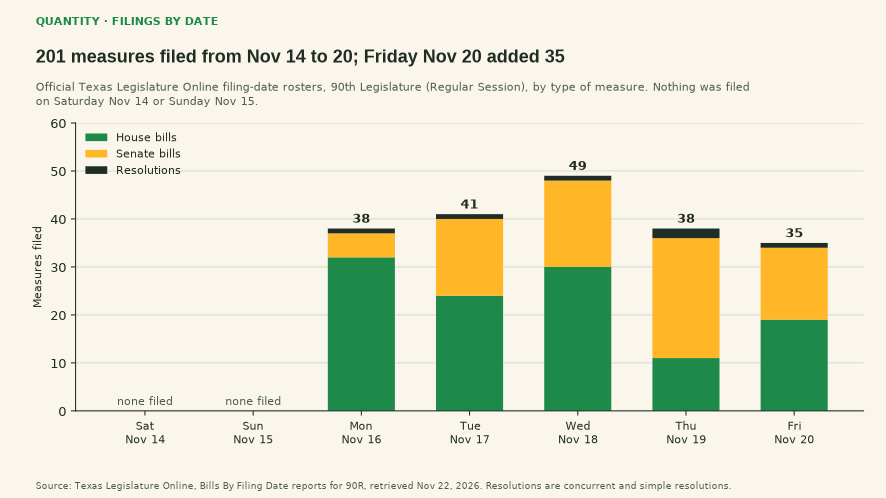
Quantity · filings by date

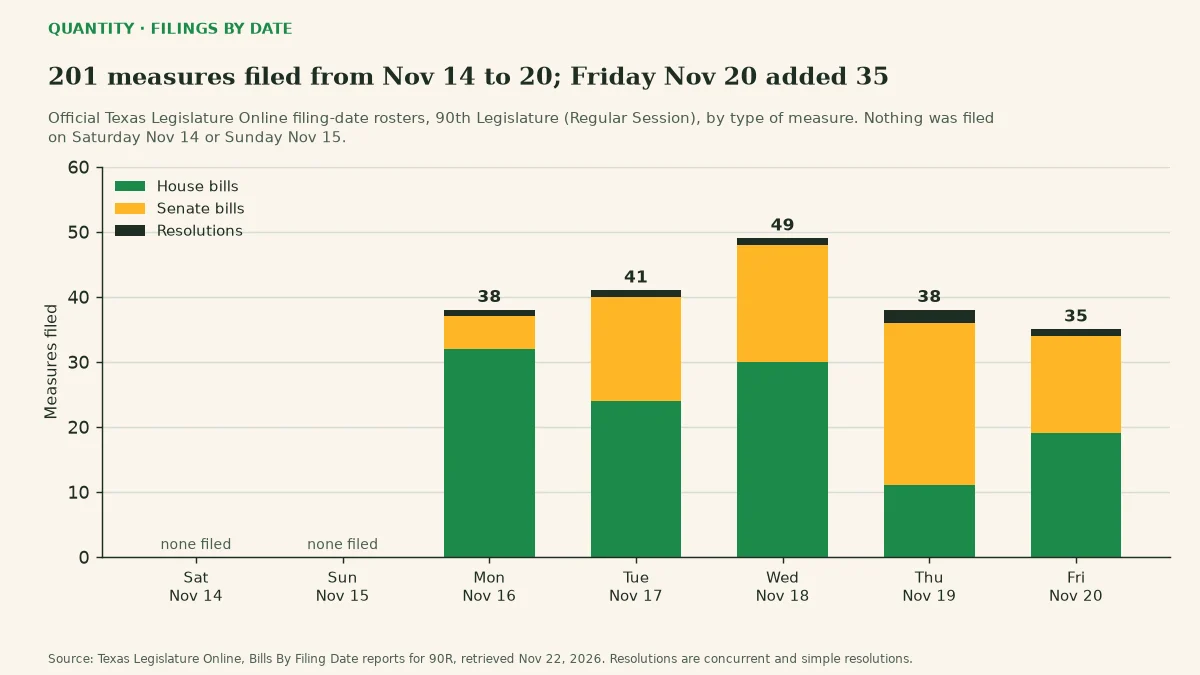
201 measures filed from Nov 14 to 20; Friday Nov 20 added 35

Official Texas Legislature Online filing-date rosters, by type of measure. Nothing was filed Nov 14 or 15.

Source: Texas Legislature Online, Bills By Filing Date reports for 90R.

Chart: Texas measures filed by date, Nov 14 to 20, 2026 · Methodology for Texas Electricity Bill Watch: 90th Legislature Filings, Nov 20, 2026 · Dataset: Texas Electricity Bill Watch: 90th Legislature Filings, Nov 20, 2026 · CC BY 4.0

Cite this chart

Power Hopper Team. "Texas measures filed by date, Nov 14 to 20, 2026." Chart. Texas Electricity Bill Watch: 90th Legislature Filings, Nov 20, 2026 dataset. Power Hopper Media Data Room, published November 22, 2026. https://powerhopper.energy/media/data/texas-electricity-bill-watch-90th-legislature-filings-nov-20-2026#chart-texas-90r-filings-by-date-nov-14-to-20-2026. Accessed [date accessed].

Data table
Texas measures filed by date, Nov 14 to 20, 2026
DateHouse billsSenate billsResolutionsTotal
Nov 140000
Nov 150000
Nov 16325138
Nov 172416141
Nov 183018149
Nov 191125238
Nov 201915135

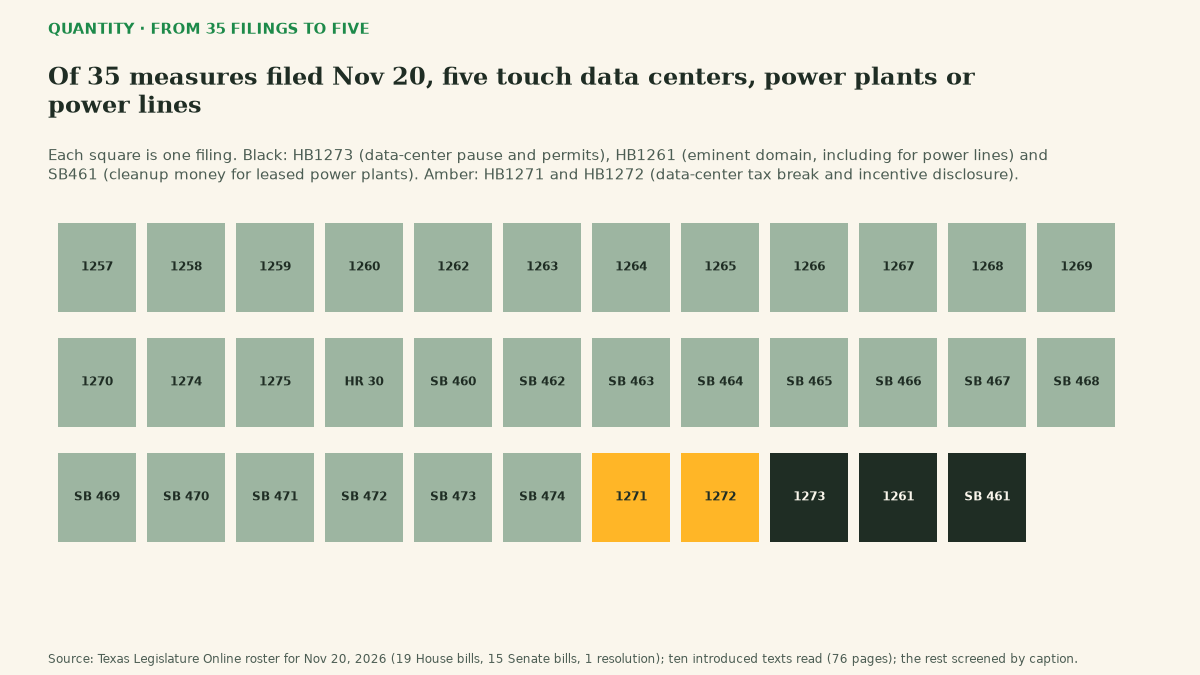
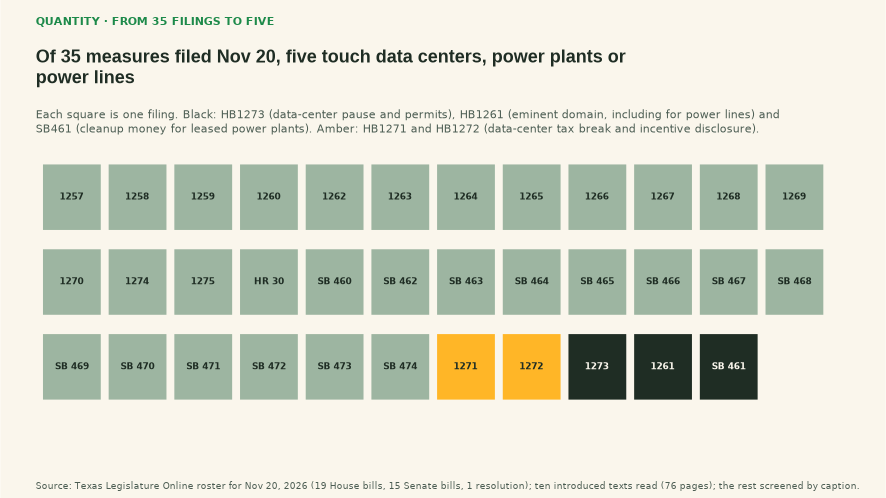
Quantity · from 35 filings to five

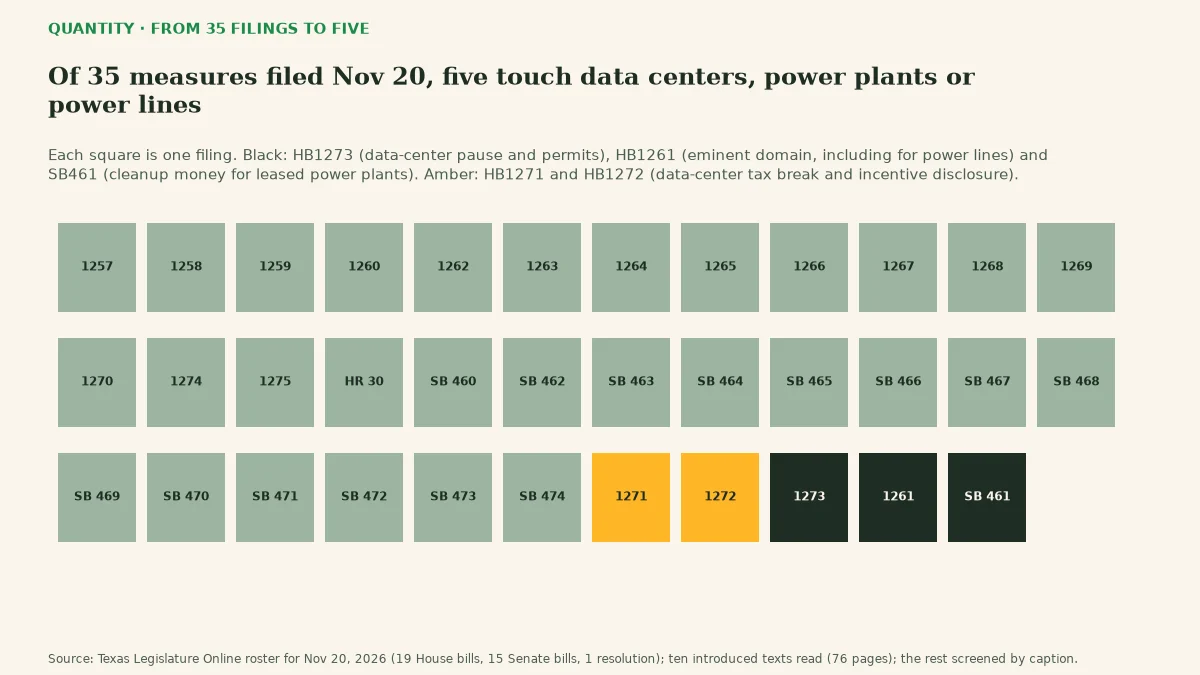
Of 35 measures filed Nov 20, five touch data centers, power plants or power lines

Each square is one filing. HB1273, HB1261 and SB461 could affect the grid; HB1271 and HB1272 are smaller data-center tax and disclosure rules.

Source: Texas Legislature Online roster for Nov 20, 2026; ten introduced texts read.

Chart: The 35 measures filed Nov 20, 2026 and the five to review · Methodology for Texas Electricity Bill Watch: 90th Legislature Filings, Nov 20, 2026 · Dataset: Texas Electricity Bill Watch: 90th Legislature Filings, Nov 20, 2026 · CC BY 4.0

Cite this chart

Power Hopper Team. "The 35 measures filed Nov 20, 2026 and the five to review." Chart. Texas Electricity Bill Watch: 90th Legislature Filings, Nov 20, 2026 dataset. Power Hopper Media Data Room, published November 22, 2026. https://powerhopper.energy/media/data/texas-electricity-bill-watch-90th-legislature-filings-nov-20-2026#chart-texas-90r-35-filings-on-nov-20-five-to-review. Accessed [date accessed].

Data table
The 35 measures filed Nov 20, 2026 and the five to review
GroupMeasures
Screened out by caption or text30
Data-center tax break and incentive disclosure (HB1271, HB1272)2
Could affect the grid (HB1273, HB1261, SB461)3

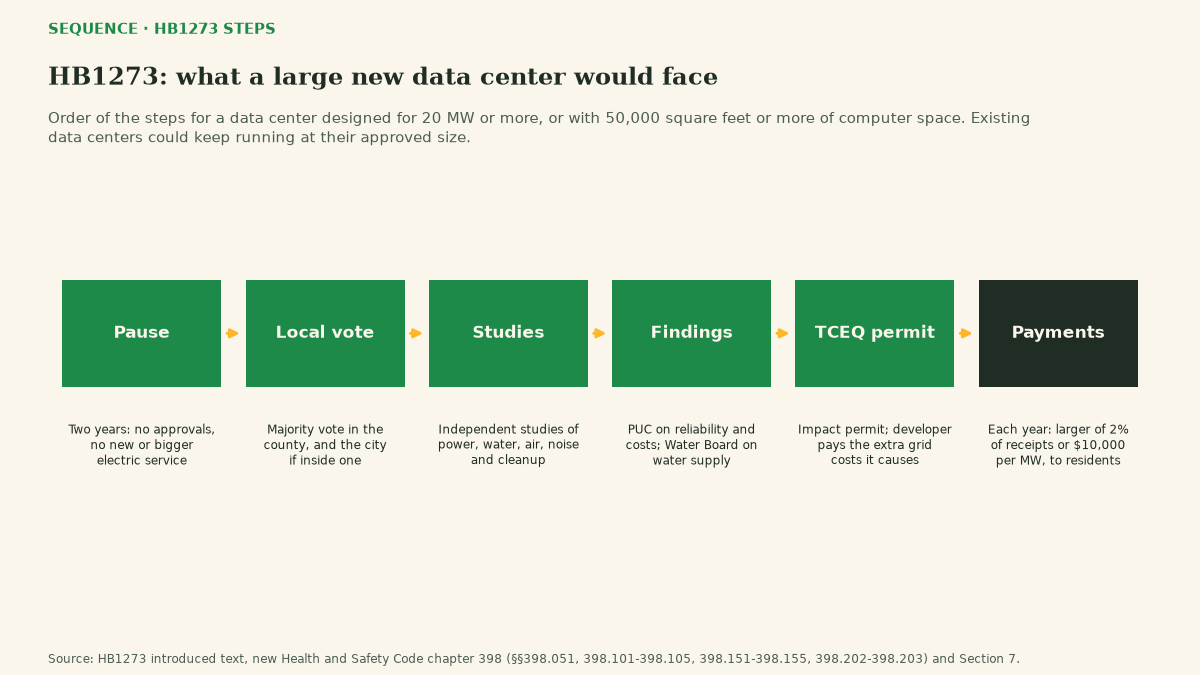
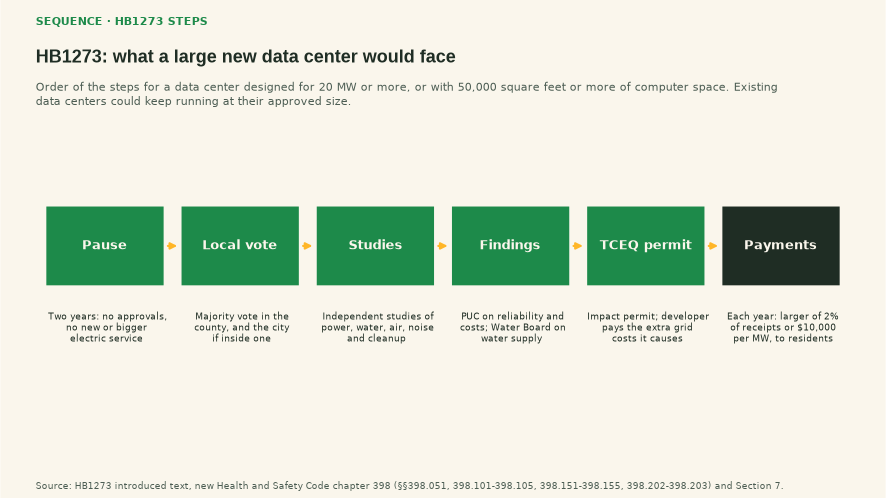
Sequence · HB1273 steps

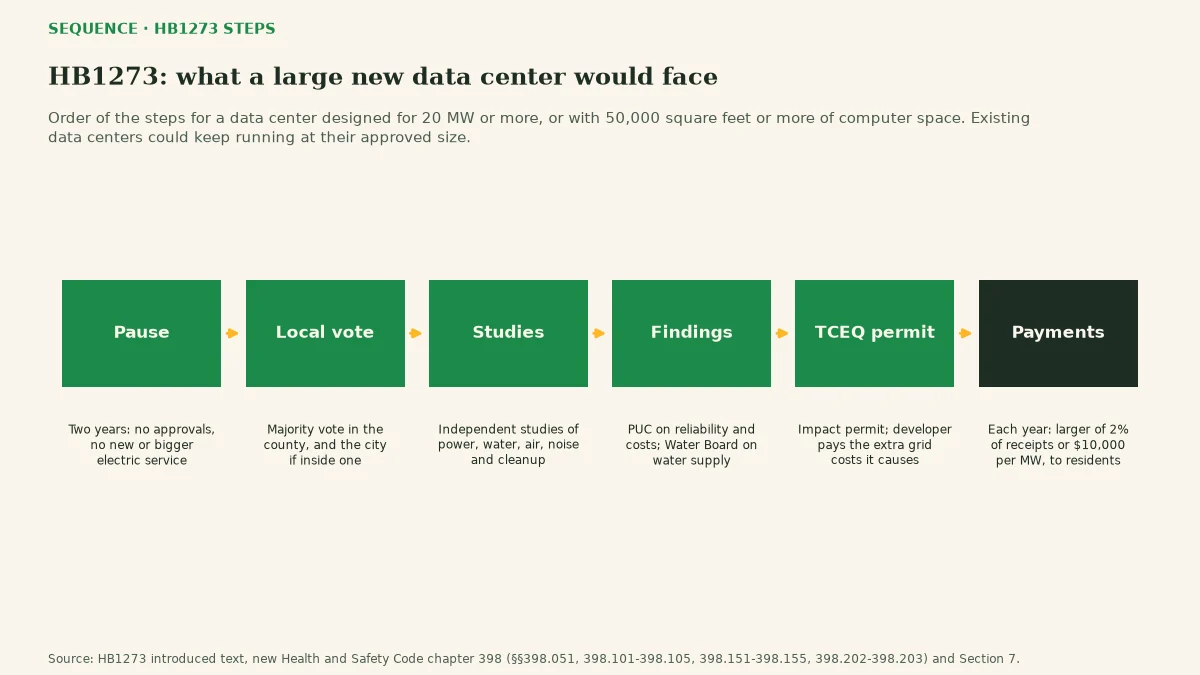
HB1273: what a large new data center would face

Pause, local vote, studies, agency findings, TCEQ permit, then yearly payments to county residents.

Source: HB1273 introduced text, Health and Safety Code chapter 398 as proposed.

Chart: HB1273: data-center pause, vote, permit and payments · Methodology for Texas Electricity Bill Watch: 90th Legislature Filings, Nov 20, 2026 · Dataset: Texas Electricity Bill Watch: 90th Legislature Filings, Nov 20, 2026 · CC BY 4.0

Cite this chart

Power Hopper Team. "HB1273: data-center pause, vote, permit and payments." Chart. Texas Electricity Bill Watch: 90th Legislature Filings, Nov 20, 2026 dataset. Power Hopper Media Data Room, published November 22, 2026. https://powerhopper.energy/media/data/texas-electricity-bill-watch-90th-legislature-filings-nov-20-2026#chart-texas-90r-hb1273-data-center-steps. Accessed [date accessed].

Data table
HB1273: data-center pause, vote, permit and payments
StepRule
PauseTwo years: no approvals, no new or bigger electric service
Local voteMajority vote in the county, and the city if inside one
StudiesIndependent studies of power, water, air, noise and cleanup
FindingsPUC on reliability and costs; Water Board on water supply
TCEQ permitImpact permit; developer pays the extra grid costs it causes
PaymentsEach year: larger of 2% of receipts or $10,000 per MW, to residents

Also checked

Five more introduced texts were read and have no electricity provision: HB1257 (collective bargaining for public employees), HB1258 (a state technology and innovation program), HB1262 (proof of groundwater for new subdivisions), HB1274 (TCEQ rules for certain solid waste facilities) and HB1275 (incorporating a general-law city).

All 35 measures filed Nov 20

Show the full roster
Measures filed Nov 20, 2026 (official author and caption)
MeasureAuthorCaptionPower Hopper review
HB1257SimmonsRelating to the right of public employees to collectively bargain with governmental entities.Read: no electricity provision
HB1258HerbertRelating to the creation of the Texas technology and innovation program.Read: no electricity provision
HB1259HerbertRelating to a franchise tax credit for taxable entities that make certain employer child-care contributions.Screened: not about electricity
HB1260McGeeRelating to the disclosure of financial interests by and the regulation of advertising by health care practitioners who promote or facilitate the sale of drugs to consumers; providing administrative and civil penalties.Screened: not about electricity
HB1261SpencerRelating to the exercise of eminent domain for a demonstrated public necessity; limiting certain condemnation powers; requiring independent review, public hearings and county elections, enhanced compensation, repurchase rights, and revenue accounting; providing court review, injunctive relief, recovery of costs, and enforcement; contingent in part on a constitutional amendment.Reviewed: limits on eminent domain, including for power lines
HB1262IsaacRelating to requirements that certain plats for the subdivision of land include evidence of groundwater supply.Read: no electricity provision
HB1263Ward JohnsonRelating to notice provided to prospective lessees of residential units on land over a closed municipal solid waste landfill facility.Screened: not about electricity
HB1264Ward JohnsonRelating to providing to parents a copy of student emergency procedures included in a public school's multihazard emergency operations plan.Screened: not about electricity
HB1265ReynoldsRelating to repealing the education savings account program.Screened: not about electricity
HB1266Gervin-HawkinsRelating to a manufacturer's disclosure of ingredients and toxic metals in lipstick and lip gloss.Screened: not about electricity
HB1267McGeeRelating to the exemption from seizure of certain funds held in a deposit account of an individual to satisfy a judgment on a consumer debt and to the protection of the proceeds of current wages.Screened: not about electricity
HB1268McGeeRelating to a suit for dissolution of a marriage and associated suit affecting the parent-child relationship when a party is pregnant.Screened: not about electricity
HB1269CraddickRelating to the enforcement of commercial motor vehicle safety standards in certain counties.Screened: not about electricity
HB1270CraddickRelating to the I-14 Advisory Committee.Screened: not about electricity
HB1271CastellanoRelating to the repeal of the exemptions from sales and use taxes for property used in certain data centers and large data center projects.Reviewed: repeal of data-center sales-tax exemptions
HB1272CastellanoRelating to the public disclosure of local economic development agreements involving data centers.Reviewed: full disclosure of local data-center incentive deals
HB1273CastellanoRelating to the siting, construction, permitting, and operation of certain data centers; requiring local option elections; imposing a temporary moratorium; establishing an annual payments to county residents; repealing certain tax exemptions; providing civil penalties.Reviewed: two-year data-center pause, local votes, state permit, resident payments
HB1274MartinezRelating to the regulation by the Texas Commission on Environmental Quality of certain solid waste processing facilities.Read: no electricity provision
HB1275CurryRelating to the incorporation of a General Law Municipality.Read: no electricity provision
HR30IsaacCongratulating the New Braunfels High School girls' cross country team on winning the 2026 UIL 5A state championship.Screened: not about electricity
SB460HallRelating to the administration of immunizations to children and adults, including required written informed consent to those immunizations and civil liability for failure to obtain the consent; providing administrative penalties.Screened: not about electricity
SB461HallRelating to the removal of certain power facilities operated on leased property.Reviewed: cleanup money for wind, solar, battery and other leased power plants
SB462ZaffiriniRelating to sentencing and community supervision procedures, including for family violence offenders.Screened: not about electricity
SB463ZaffiriniRelating to the disclosure of confidential juvenile records to a managed assigned counsel program.Screened: not about electricity
SB464MilesRelating to a notification requirement if certain public schools do not have a nurse assigned to the school during all instructional hours.Screened: not about electricity
SB465MilesRelating to the misuse of money received for an open-enrollment charter school to support an out-of-state school.Screened: not about electricity
SB466MilesRelating to the removal of a conservator, board of managers, or other alternative management of a campus or school district in certain circumstances.Screened: not about electricity
SB467MilesRelating to the issuance of a transcript by a public institution of higher education to a student who fails to pay certain student fees.Screened: not about electricity
SB468MilesRelating to prohibiting a public school from discriminating or retaliating against an employee for reporting certain misconduct.Screened: not about electricity
SB469MilesRelating to parental notification that a public school educator was engaged in romantic or sexual misconduct with a student enrolled at the school.Screened: not about electricity
SB470MilesRelating to the applicability of certain financial provisions to campus or campus program charter schools.Screened: not about electricity
SB471MilesRelating to measures to assist students enrolled at public institutions of higher education who are homeless or who are or were in foster care.Screened: not about electricity
SB472MilesRelating to authorizing school districts to provide funding using money received under the Foundation School Program to community-based organizations for purposes of reimbursing private employers for paid internships provided to certain students in career and technology education programs in the district.Screened: not about electricity
SB473MilesRelating to the requirement for educators serving as superintendents, directors, or principals of educational entities to report certain educator misconduct; increasing an administrative penalty.Screened: not about electricity
SB474MilesRelating to the consideration of differentials among students from different racial and ethnic groups based on sex under the public school accountability system.Screened: not about electricity

Downloads

Bill reviews (CSV) · Full Nov 20 roster (CSV) · Key numbers (JSON) · SHA-256 checksums

Notes and limits

Counts come from the official Texas Legislature Online Bills By Filing Date reports for Nov 14 to 20, 2026, retrieved Nov 22. Every author and caption in the roster was checked against the official Nov 20 report, and the five reviewed bills' histories show Nov 20 as the filing date.

Each measure was screened by its official caption. Ten introduced texts filed Nov 20 were read in full (HB1273, HB1261, SB461, HB1271, HB1272, HB1257, HB1258, HB1262, HB1274, HB1275; 76 pages).

Current-law references were checked against the Texas Utilities Code (§181.004, §37.0561, chapter 301), Tax Code (§§151.359, 151.3595, 313.009) and Government Code (§§403.0246, 403.0247).

Effects on electricity customers are Power Hopper's reading of the bill text, not a forecast. Filed bills can change or die before the session ends.

Power Hopper is not affiliated with or endorsed by the Texas Legislature, the Texas Legislative Council or any lawmaker.

Power Hopper (BJW Ventures LLC d/b/a Power Hopper) is a PUCT-registered electricity broker, BR260201; registration is not a PUCT endorsement. Electricity providers may pay us a commission if you sign up through us. Power Hopper is not a retail electric provider, utility or transmission and distribution utility. This brief was prepared with AI assistance.