
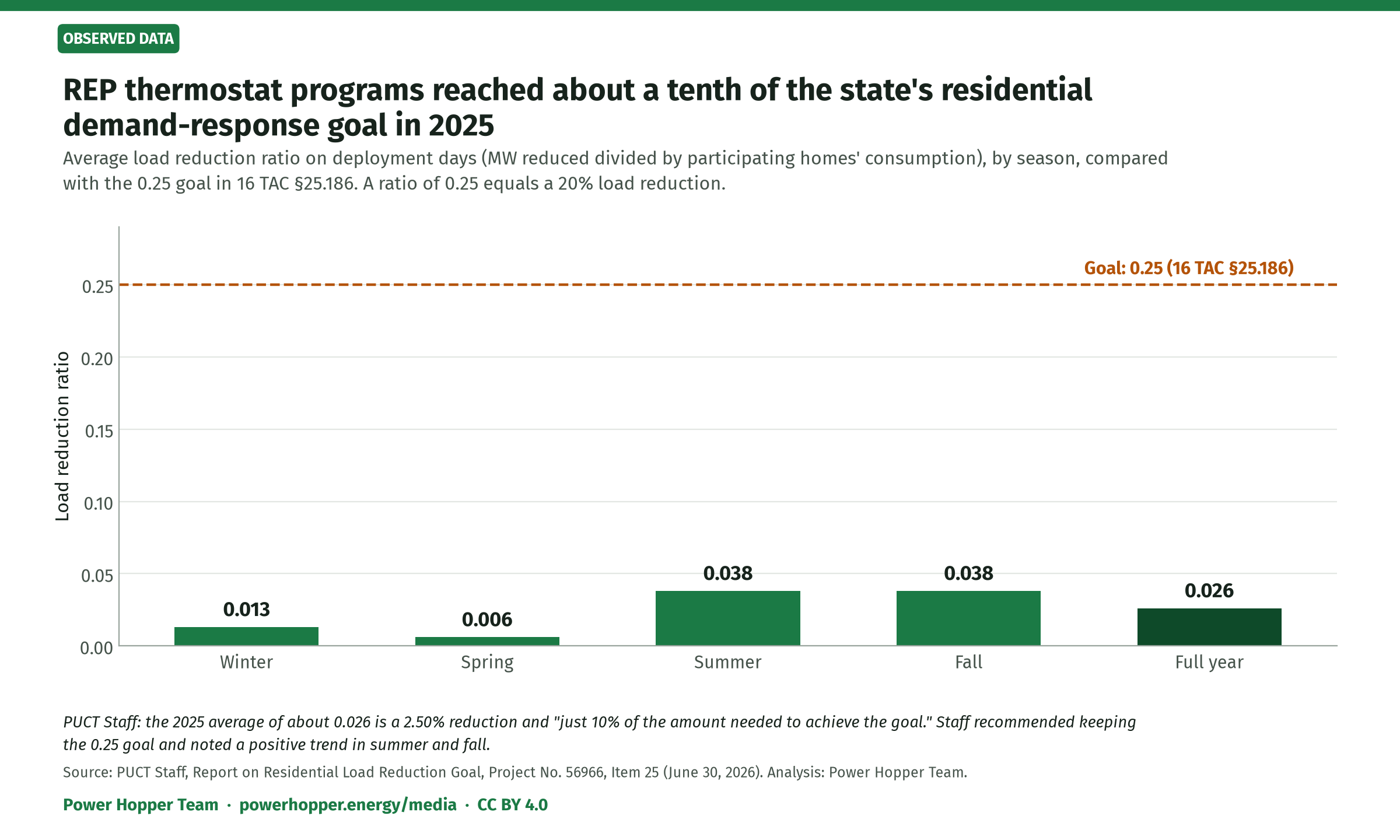
The short version. A Texas rule in effect since Jan. 1, 2025 (16 TAC §25.186) lets retail electric providers (REPs) offer programs that use customers' smart thermostats and other connected devices to cut demand at peak times, and sets a residential load-reduction goal. A review filed by Public Utility Commission of Texas (PUCT) Staff on June 30, 2026, found that on the 34 days in 2025 when REPs called at least 1,000 homes, participating homes cut their load by about 2.5% on average. The goal in 16 TAC §25.186 is a 20% reduction (a 0.25 ratio), so programs reached about a tenth of it. Enrollment grew from 55,125 homes in the first quarter of 2025 to 145,323 in the fourth. In CenterPoint Houston's area, the utility's $100 thermostat incentive is paid to the REP, not the homeowner. Austin Energy and CPS Energy, municipal utilities outside the retail choice market whose customers cannot choose a REP, credit their own customers directly. Filings also show that the wider efficiency programs these incentives sit in report large modeled benefits.
What the state review found
PUCT Staff looked at 334 ERCOT daily peak periods from Jan. 1 to Nov. 30, 2025 (Project No. 56966, Item 25). REPs deployed at least one home on 302 of those days, but "nearly 85% of days examined involved fewer than 100 deployments." Only 34 days, 10.18%, reached the 1,000-home level ERCOT needs to estimate a baseline.
On those 34 days the average load reduction ratio was 0.026. Performance was stronger in summer and fall (0.038 each) than in winter (0.013) and spring (0.006), which Staff called "a positive trend" while noting that more data is needed. By Power Hopper's calculation from the same table, each deployed home cut about 0.19 to 0.42 kW on average, depending on the season. For comparison, a study by The Brattle Group, prepared for NRG and Google and filed in ERCOT's NPRR1296 proceeding (Item 14b, Jan. 16, 2026), assumed 1 kW per customer when it modeled a residential program; that is a modeling input, not a measurement.
Staff recommended keeping the 0.25 goal. It also pointed to lower wholesale prices: the Independent Market Monitor's average ERCOT real-time price fell from $179.24/MWh in 2021 to $36.94 in 2025, and Staff wrote that lower prices "may diminish demand response incentives."
Homes enrolled in programs that cannot be combined
The rule prohibits a home in a REP device program from also being in ERCOT's Emergency Response Service (ERS) or a utility (TDU) load management program. Staff's data shows 7,206 to 7,932 homes per quarter in 2025 were in both. That is 14.4% of REP enrollment in the first quarter and 5.0% in the fourth, by Power Hopper's calculation, because REP enrollment grew faster than the overlap.
Staff wrote that REPs "have limited visibility" into multiple sign-ups and that customers may not know, for example when a landlord or a previous owner enrolled the home. Staff said it is working with REPs and ERCOT before recommending enforcement. Staff also recommended eliminating or significantly reducing residential participation in ERS and TDU load management, noting that TDU load management programs (combined residential and commercial) offered 380.4 MW in 2024 and 410 MW in 2025 and "have never been deployed by ERCOT." ERCOT may call them only at or near an Energy Emergency Alert level 2, and none occurred in the period studied.
Where the thermostat incentive goes
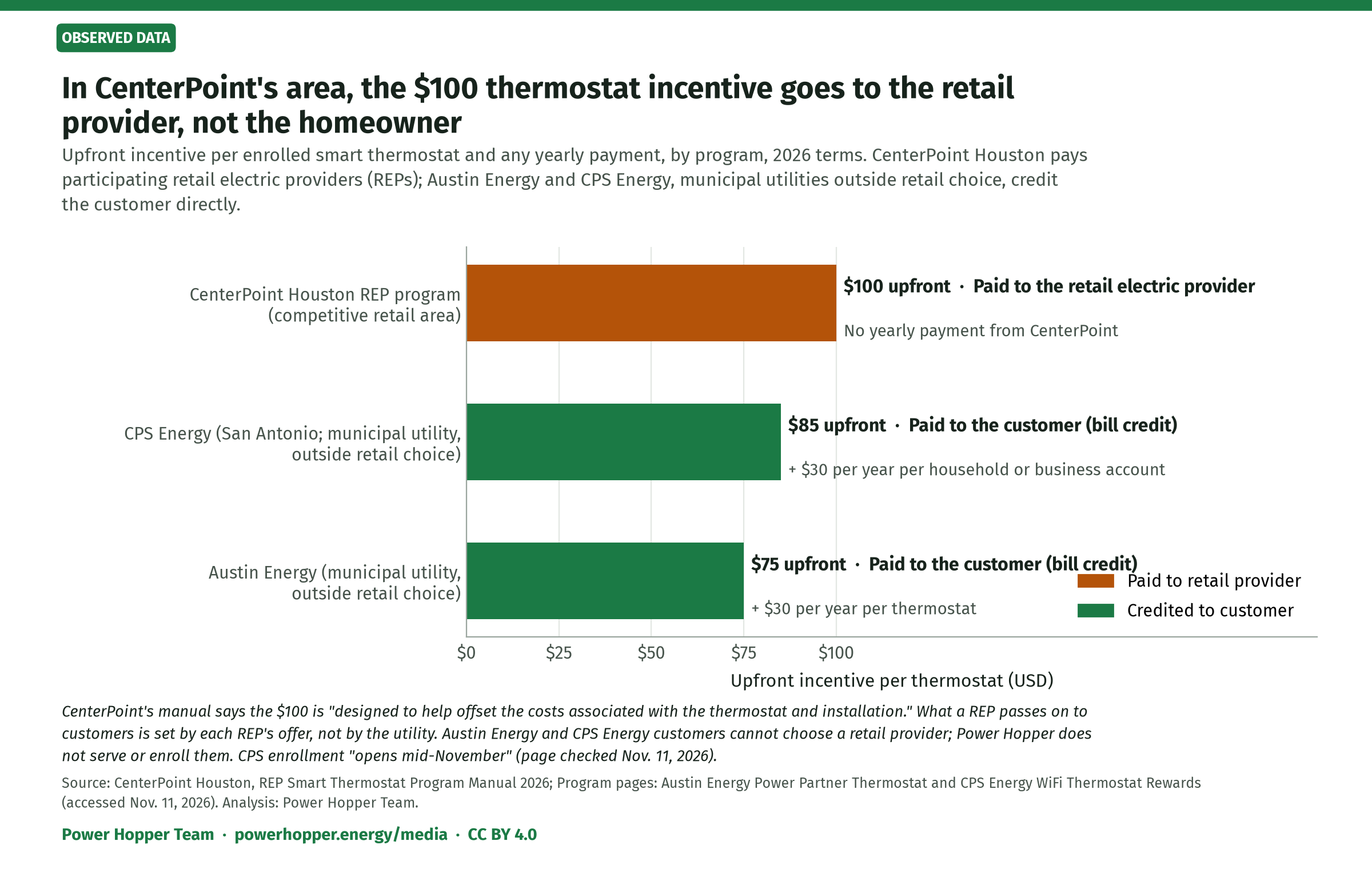
CenterPoint Houston's 2026 manual offers $100 per installed ENERGY STAR smart thermostat, up to two per meter, and states: "CenterPoint pays all incentives directly to the Retail Electric Providers, not to customers." The incentive is "designed to help offset the costs associated with the thermostat and installation." What a REP passes on is set by each REP's own offer. In 2025 CenterPoint paid $1,846,200 for 18,462 thermostats, $100.00 each, and it has budgeted $2 million a year for 2026 and 2027. CenterPoint counts energy savings from the program but claims no peak demand savings.
Austin Energy and CPS Energy are municipal utilities outside the retail choice market; their customers cannot choose a REP, and Power Hopper does not serve them or enroll anyone in their programs. These are utility demand-response programs, not retail electricity plans. Austin Energy's Power Partner page lists a $75 bill credit per enrolled thermostat (limit five) plus $30 a year per thermostat kept enrolled. CPS Energy's WiFi Thermostat Rewards page lists an $85 bill credit per enrolled thermostat plus a $30 yearly credit per household or business account; on Nov. 11, 2026, the page said enrollment "opens mid-November." REP thermostat programs, where offered, set their own terms.
When the PUCT adopted the rule in December 2024, it said the statute "does not prescribe the manner in which customers must be compensated," and the Commission declined to require compensation. ERCOT's pending NPRR1296 would pay for measured residential reductions during each season's highest net-load hours, with payments going to the Qualified Scheduling Entities that represent REPs. Its proposed seasonal caps equal about 500 MW, by Power Hopper's calculation; above a cap, the payment rate would be reduced. It does not set how REPs share payments with customers, and it has been tabled since September 2025.
Efficiency charges and their benefits
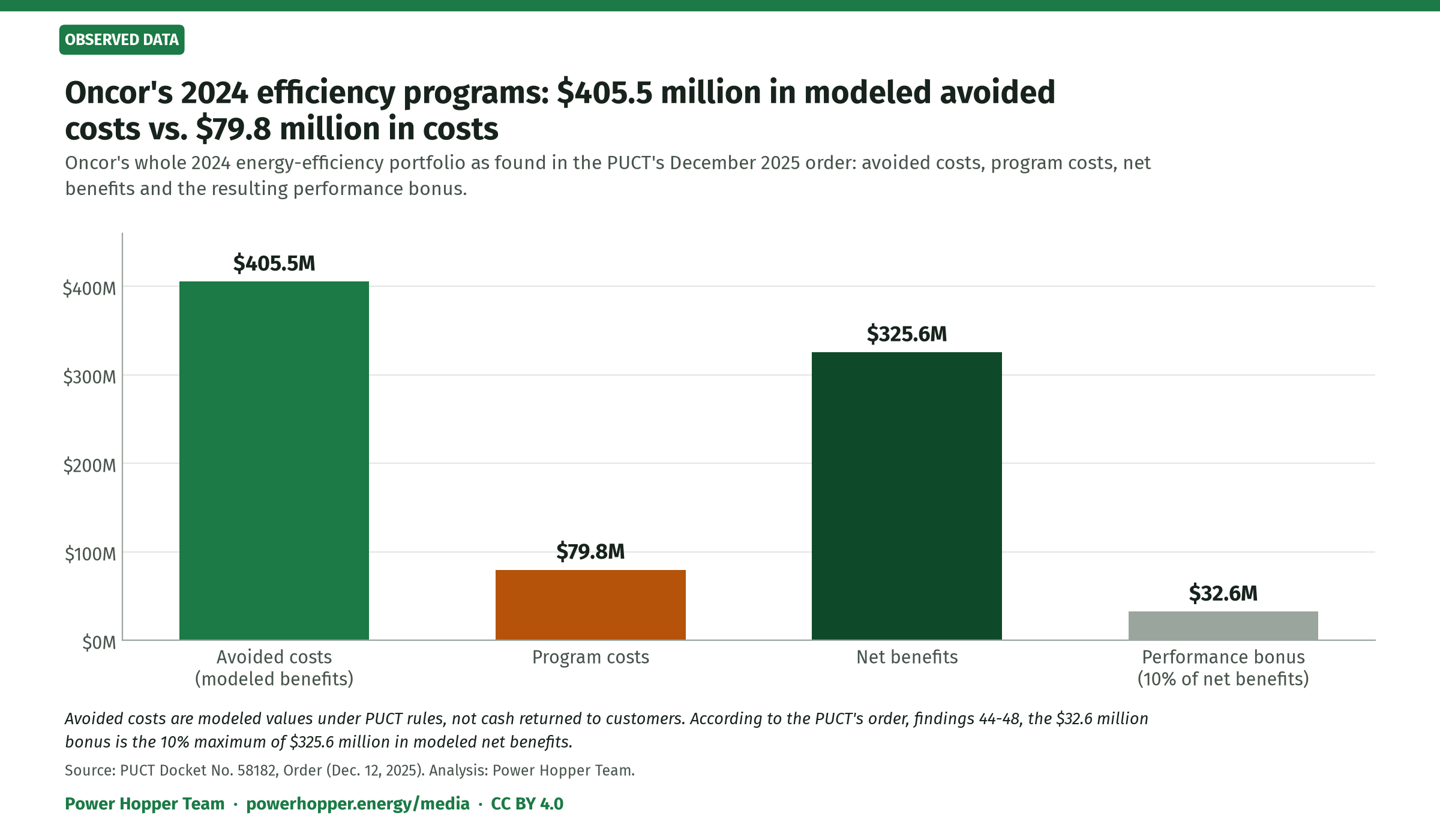
Smart thermostat incentives are a small part of utility energy-efficiency portfolios, which customers fund through a line-item charge, the Energy Efficiency Cost Recovery Factor (EECRF). CenterPoint's approved 2026 EECRF is $95.8 million, of which $40.3 million (42%) is a performance bonus for 2024 results. Oncor's is $104.8 million, including a $32.6 million bonus (31%).
Those bonuses depend on how far a utility exceeds its savings goals and are calculated from modeled net benefits. According to the PUCT's order, Oncor's 2024 programs reported $405.5 million in modeled avoided costs against $79.8 million in program costs, or $325.6 million in net benefits; the $32.6 million bonus is the 10% maximum of that amount.
What the state's efficiency manual credits a thermostat with
The state's Technical Reference Manual (TRM 13.0, Vol. 2, Table 64), which utilities use to count efficiency-program savings, assigns an ENERGY STAR connected thermostat deemed savings of 1,271 to 1,427 kWh a year, depending on climate zone, and says summer and winter demand savings "shall not be claimed" for that measure. Deemed values are averages used for program accounting, not a measurement or estimate for any home.
About the data
Figures in this article come from these filings: the PUCT Staff report (Project No. 56966, Item 25), the rule adoption order (Item 24), CenterPoint's 2026 Energy Efficiency Plan and Report (Project No. 59166, Item 35) and data responses (Docket No. 59826, Item 27), the Oncor EECRF order (Docket No. 58182), the TNMP settlement (Docket No. 59791, pending), ERCOT NPRR1296 filings and the Texas Technical Reference Manual 13.0, Vol. 2 (program year 2026). Austin Energy and CPS Energy terms come from their program pages as of Nov. 11, 2026. Power Hopper calculations are labeled. Source documents, CSVs and charts are on the data page under CC BY 4.0.
Power Hopper is not affiliated with or endorsed by the PUCT, ERCOT, the Independent Market Monitor (Potomac Economics), CenterPoint Energy Houston Electric, Oncor Electric Delivery, Texas-New Mexico Power, Austin Energy, CPS Energy, The Brattle Group, NRG, Google, ENERGY STAR or the U.S. Environmental Protection Agency, or any thermostat manufacturer or retail electric provider.
Customers of most city-owned utilities and electric cooperatives in Texas cannot choose a different electricity provider. If you live where retail choice is available, you can compare plans with Power Hopper. Power Hopper is a PUCT-registered broker, BR260201; electricity providers may pay us a commission if you sign up through us.
Power Hopper (BJW Ventures LLC d/b/a Power Hopper) is a PUCT-registered electricity broker, BR260201; registration is not a PUCT endorsement. Electricity providers may pay us a commission if you sign up through us. Power Hopper is not a retail electric provider, utility or transmission and distribution utility, and is not affiliated with or endorsed by the PUCT, ERCOT or any utility, supplier or data provider named above. This brief was prepared with AI assistance.