
The short version. Of the 116 measures filed in the Texas Legislature on Nov. 10, 2026, one would change how electricity is taxed. HB 1064, by Rep. Jeff Barry, would exempt electricity sold to a city, county or other political subdivision from the state's gas, electric and water utility (gross receipts) tax, and would direct utilities and retail electric providers to adjust those customers' bills to match. The bill has been filed only. It has not been referred to committee, and it is not law. Filing the bill does not change the current tax.
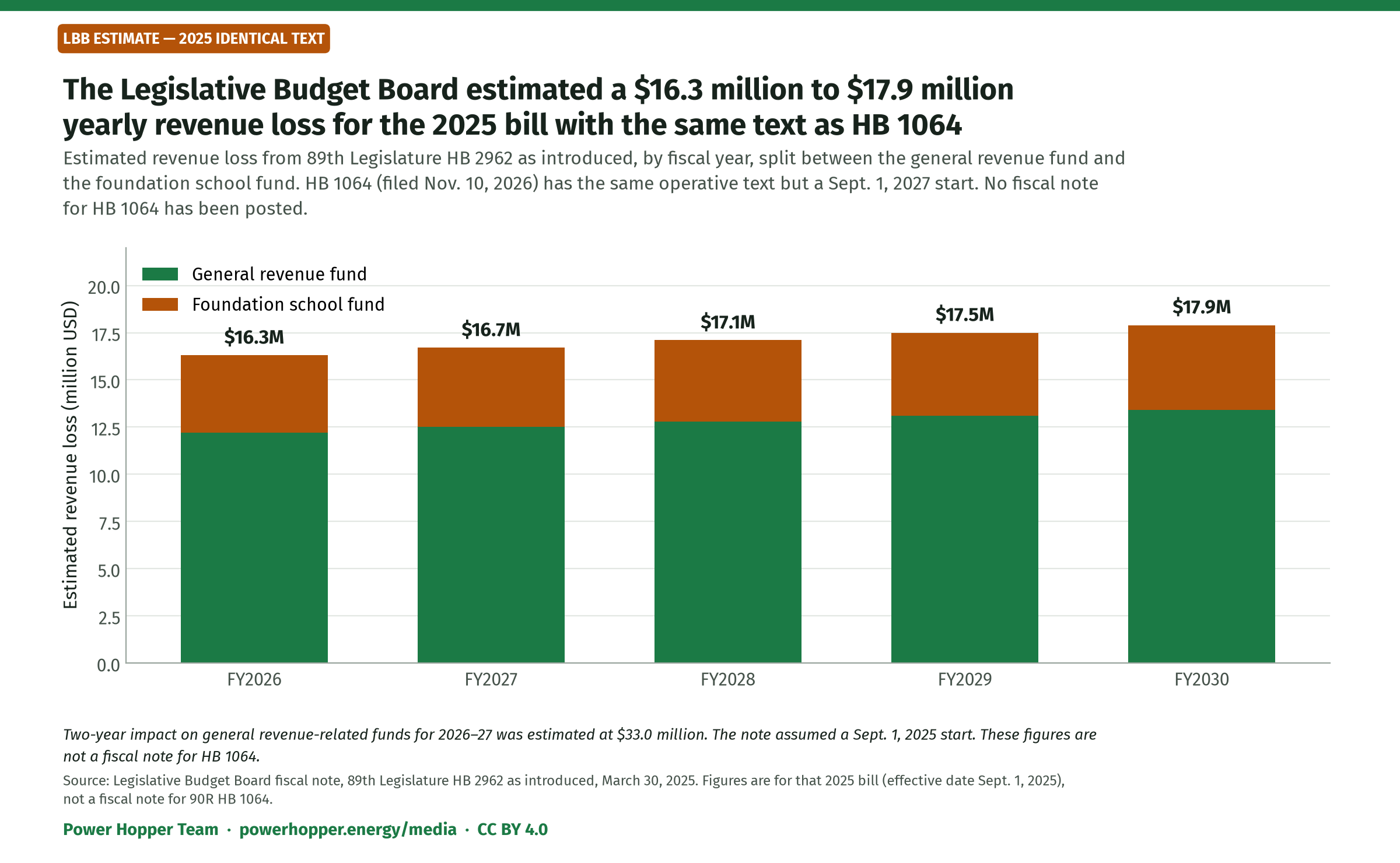
The operative text is the same as Barry's 2025 bill, HB 2962, except for the start date: Sept. 1, 2027, instead of Sept. 1, 2025. HB 2962 was heard in House Ways & Means on March 31, 2025, and left pending. The Legislative Budget Board's fiscal note for that earlier bill, dated March 30, 2025, estimated a revenue loss of $16.3 million in fiscal 2026, rising to $17.9 million in fiscal 2030, or $33.0 million over the 2026–27 biennium. Those figures assume a Sept. 1, 2025 start. No fiscal note for HB 1064 has been posted.
School districts have been exempt from the tax on their electricity purchases since Jan. 1, 2024, under 2019's HB 2263, which passed the House 146-0 with 1 present, not voting, on April 10, 2019, and the Senate 31-0 on May 2, 2019.
What HB 1064 would do
The introduced text, posted on Texas Legislature Online, would amend Tax Code section 182.022(d). The current exemption for a "public school district customer" would become an exemption for a "political subdivision." Gross receipts from electricity sold to a political subdivision would no longer be taxed under that chapter.
The bill would also require a pass-through. As soon as practicable after the effective date, the Public Utility Commission of Texas (PUCT), for an electric utility regulated under Chapter 36 of the Utilities Code, would have to provide for an adjustment of that utility's billing of a political subdivision to reflect any decrease in the utility's tax liability caused by the exemption. The adjustment would not be a rate case. No PUCT action would be required if an existing rate order already accounted for the decrease. Retail electric providers would have to make the same billing adjustment for political-subdivision customers.
The Act would take effect Sept. 1, 2027. As of Nov. 11, 2026, the official history page still showed only "H Filed" on Nov. 10, 2026.
The bill does not state a per-customer bill effect, and it does not say how the adjustment would appear on a bill. Residential and business customers are not directly named in the text.
The tax today
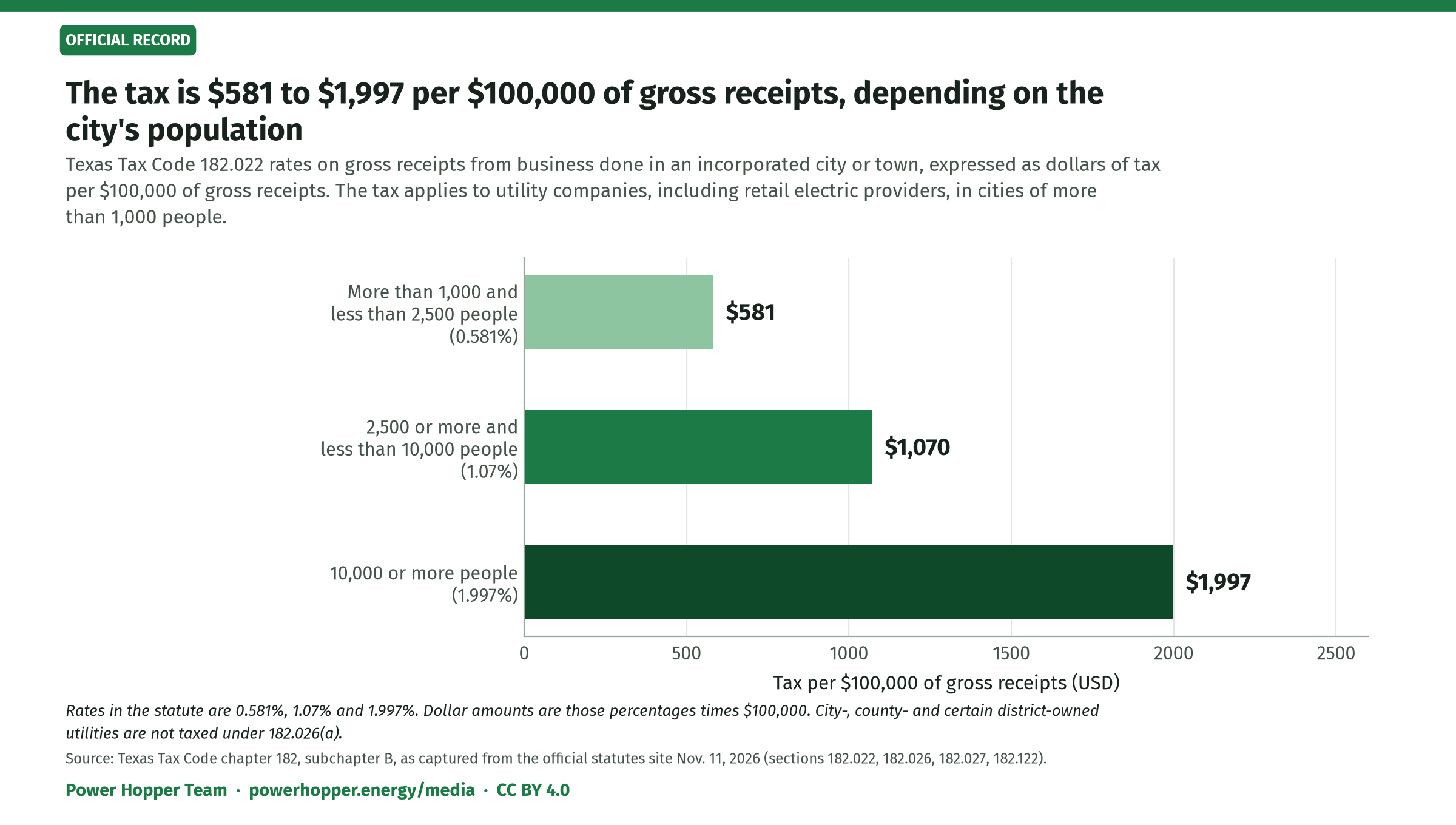
The tax is in Tax Code chapter 182, subchapter B. It is imposed on "utility companies," which include retail electric providers, for sales in incorporated cities or towns of more than 1,000 people. The rates on gross receipts are 0.581% (more than 1,000 and less than 2,500 people), 1.07% (2,500 or more and less than 10,000), and 1.997% (10,000 or more). That is $581, $1,070 or $1,997 of tax per $100,000 of gross receipts.
The tax does not apply to a utility company owned and operated by a city, town, county, water improvement district or conservation district (182.026(a)). A retail electric provider owned, operated or controlled by an electric cooperative is taxed (182.027). Revenue is allocated one-fourth to the foundation school fund and three-fourths to general revenue (182.122).
Two exemptions already exist: electricity generated by an advanced clean energy project (182.022(c), added in 2007) and sales to public school district customers (182.022(d), added by HB 2263 and effective Jan. 1, 2024).
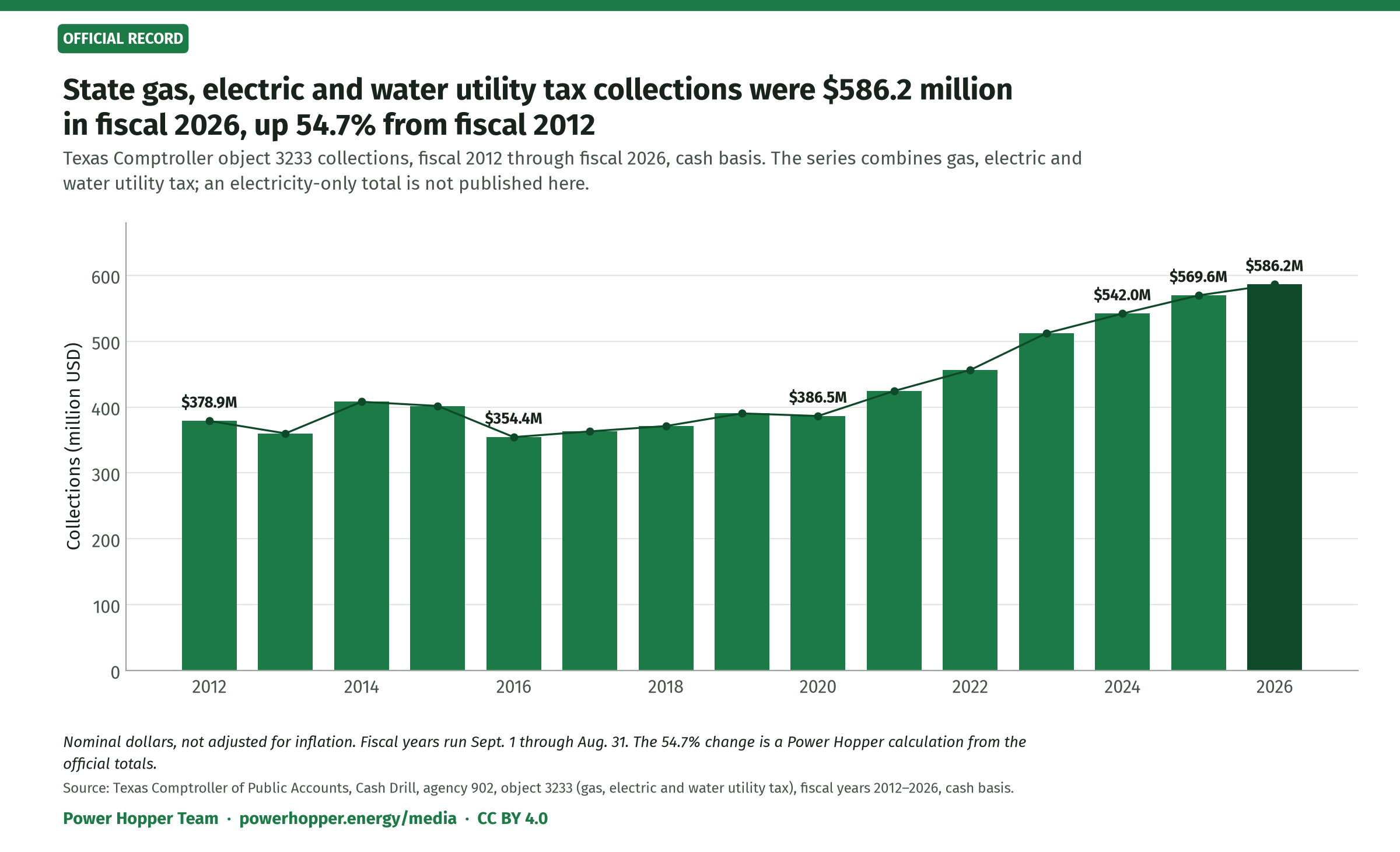
The Comptroller records this tax as object 3233, which combines gas, electric and water. Collections were $586.2 million in fiscal 2026 (Sept. 1, 2025, through Aug. 31, 2026), $569.6 million in fiscal 2025, and $378.9 million in fiscal 2012. That is a 54.7% increase from fiscal 2012 to fiscal 2026, in nominal dollars, by Power Hopper's calculation from the official totals. An electricity-only total is not published in the Comptroller series used here.
The 2025 predecessor and the state's estimate
A character-by-character comparison of the introduced texts shows that HB 1064 and HB 2962 differ only in the year of the effective date. HB 2962 was filed Feb. 18, 2025, referred to House Ways & Means on March 20, 2025, and, on March 31, 2025, was the subject of a public hearing at which a committee substitute was considered and testimony was recorded. It was left pending the same day and did not become law.
The Legislative Budget Board's fiscal note on HB 2962 as introduced, dated March 30, 2025, and addressed to Ways & Means Chair Morgan Meyer, estimated these revenue losses:
| Fiscal year | General revenue fund | Foundation school fund | Total |
|---|---|---|---|
| 2026 | $12.2 million | $4.1 million | $16.3 million |
| 2027 | $12.5 million | $4.2 million | $16.7 million |
| 2028 | $12.8 million | $4.3 million | $17.1 million |
| 2029 | $13.1 million | $4.4 million | $17.5 million |
| 2030 | $13.4 million | $4.5 million | $17.9 million |
The two-year impact on general revenue-related funds for 2026–27 was estimated at $33.0 million. The Board's method, as stated in the note, was to extrapolate electricity spending from selected political-subdivision budgets, reduce the amount for sales by municipally owned utilities and electric cooperatives, and apply the statutory rates.
Those dollars should not be read as the cost of HB 1064. They assume a Sept. 1, 2025 start, and a new fiscal note would be needed for a Sept. 1, 2027 start. Later-version fiscal notes for HB 2962 were not posted.
For scale only, the $16.3 million fiscal 2026 figure is about 2.8% of the $586.2 million actually collected from object 3233 in fiscal 2026 (Power Hopper calculation: 16,300,000 / 586,230,265.58 = 2.78%). The numerator is electricity-only; the denominator includes gas and water, so electricity's share of the tax is larger than 2.8%.
What else was filed on Nov. 10
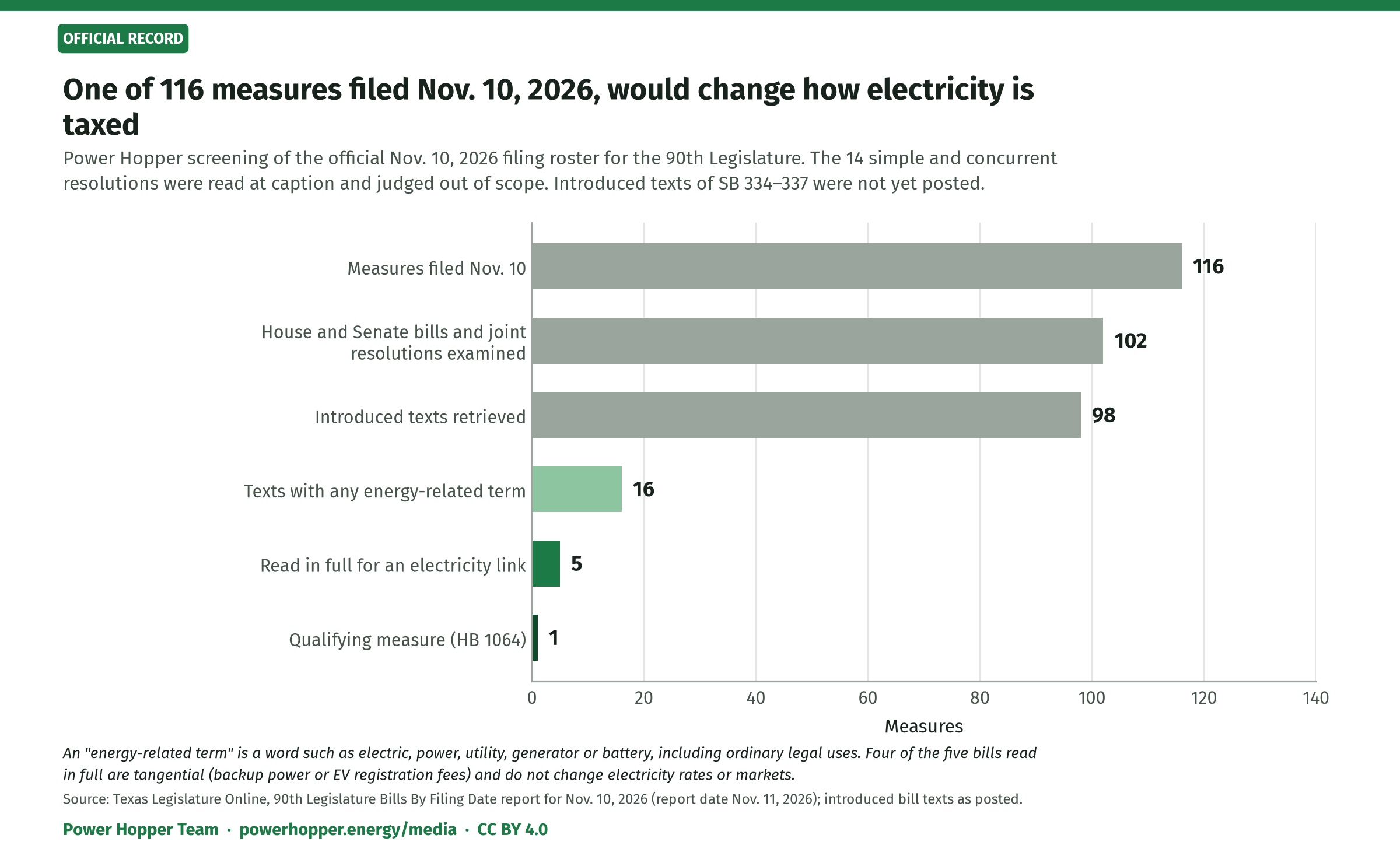
Texas Legislature Online's filing-date report for Nov. 10, 2026, lists 116 measures: 71 House bills (HB 1011 through HB 1081), 28 Senate bills (SB 310 through SB 337), 3 House joint resolutions, 12 House resolutions, and one House and one Senate concurrent resolution. No Senate joint resolution was filed that day. Every last action on the roster is "H Filed" or "S Filed" dated Nov. 10, 2026.
Power Hopper treated a measure as qualifying if the introduced text would change the electricity gross receipts tax, electricity rates, electricity markets, or utility structure; as tangential if it mentions electricity or power but would not make those changes; and as out of scope if it is a simple or concurrent resolution (caption only). SB 334–337 were examined by caption only, because the introduced texts were not posted.
Power Hopper examined the 102 House and Senate bills and joint resolutions, retrieved 98 introduced texts (SB 334 through SB 337 were not yet posted), and read in full every bill with a plausible electricity link. Besides HB 1064, four bills mention power or electricity but do not change rates, markets or utility structure: SB 315, SB 317 and SB 320, all by Sen. Miles, on backup power or elevator operability at senior housing and on generator fuel at dialysis facilities; and HB 1072, by Rep. Spencer, on allocation of electric-vehicle registration fees.
On Nov. 10 Barry also filed HB 1044, HB 1056 and HB 1059, none of which concerns electricity. No official record retrieved for this article states why the exemption was filed or refiled.
Limitations
- Bills are proposals. Nothing here predicts whether HB 1064 will be referred, heard or enacted.
- The Legislative Budget Board figures are for 2025's HB 2962, not for HB 1064.
- Object 3233 combines three utilities; an electricity-only collection total is not in the source used here.
- The statute taxes cooperative-owned retail electric providers (182.027), while the 2025 fiscal note treats electric cooperatives as not subject to the tax. How cooperatives are treated in practice is not settled in the records reviewed for this article.
- Introduced texts of SB 334 through SB 337 had not been posted when the roster was checked on Nov. 11, 2026, and were still unposted as of 9:46 a.m. CT that day. Their captions do not concern electricity.
- Power Hopper is not affiliated with or endorsed by the Texas Legislature, the Legislative Budget Board, the Texas Comptroller of Public Accounts, the Public Utility Commission of Texas, ERCOT, the House Committee on Ways & Means, or any legislator named in this article, including Rep. Jeff Barry, Sen. Miles, Rep. Spencer, and Ways & Means Chair Morgan Meyer.
A dataset, charts and the underlying tables are in the Media Data Room.
Power Hopper is not affiliated with or endorsed by the Texas Legislature, the Legislative Budget Board, the Texas Comptroller of Public Accounts, the Public Utility Commission of Texas, ERCOT, the House Committee on Ways & Means, or any legislator named in this article, including Rep. Jeff Barry, Sen. Miles, Rep. Spencer, and Ways & Means Chair Morgan Meyer.
Customers of most city-owned utilities and electric cooperatives in Texas cannot choose a different electricity provider. If you live where retail choice is available, you can compare plans with Power Hopper. Power Hopper is a PUCT-registered broker, BR260201; electricity providers may pay us a commission if you sign up through us.
Power Hopper (BJW Ventures LLC d/b/a Power Hopper) is a PUCT-registered electricity broker, BR260201; registration is not a PUCT endorsement. Electricity providers may pay us a commission if you sign up through us. Power Hopper is not a retail electric provider, utility or transmission and distribution utility, and is not affiliated with or endorsed by the PUCT, ERCOT or any utility, supplier or data provider named above. This brief was prepared with AI assistance.