
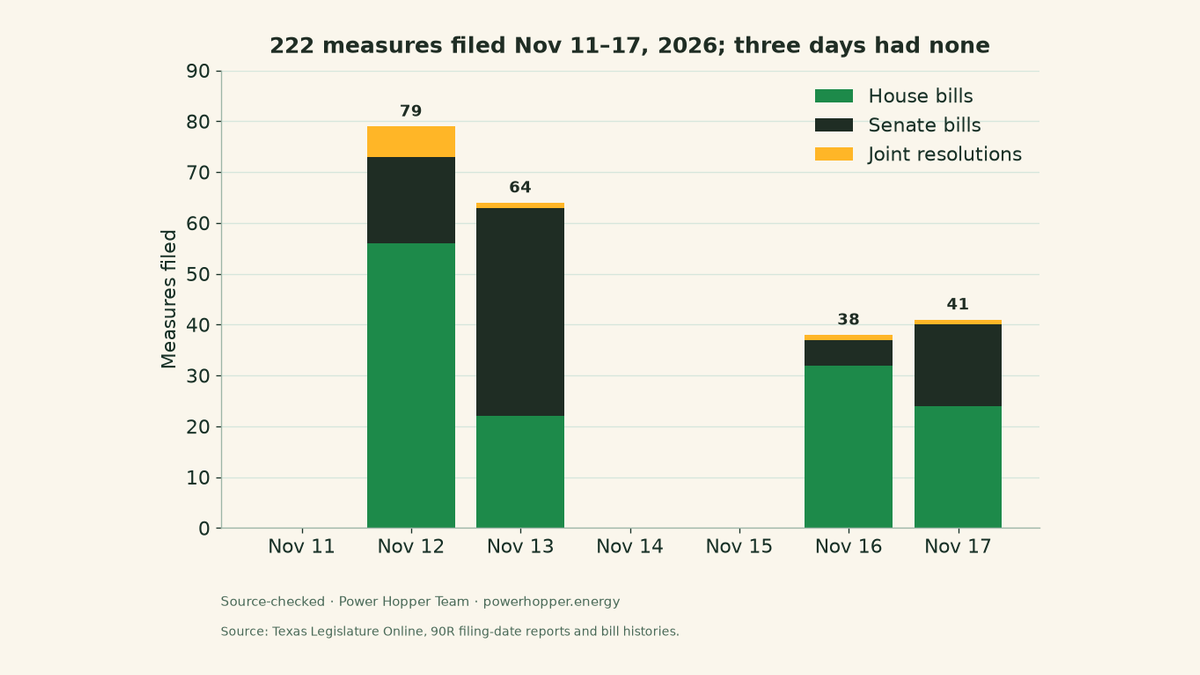
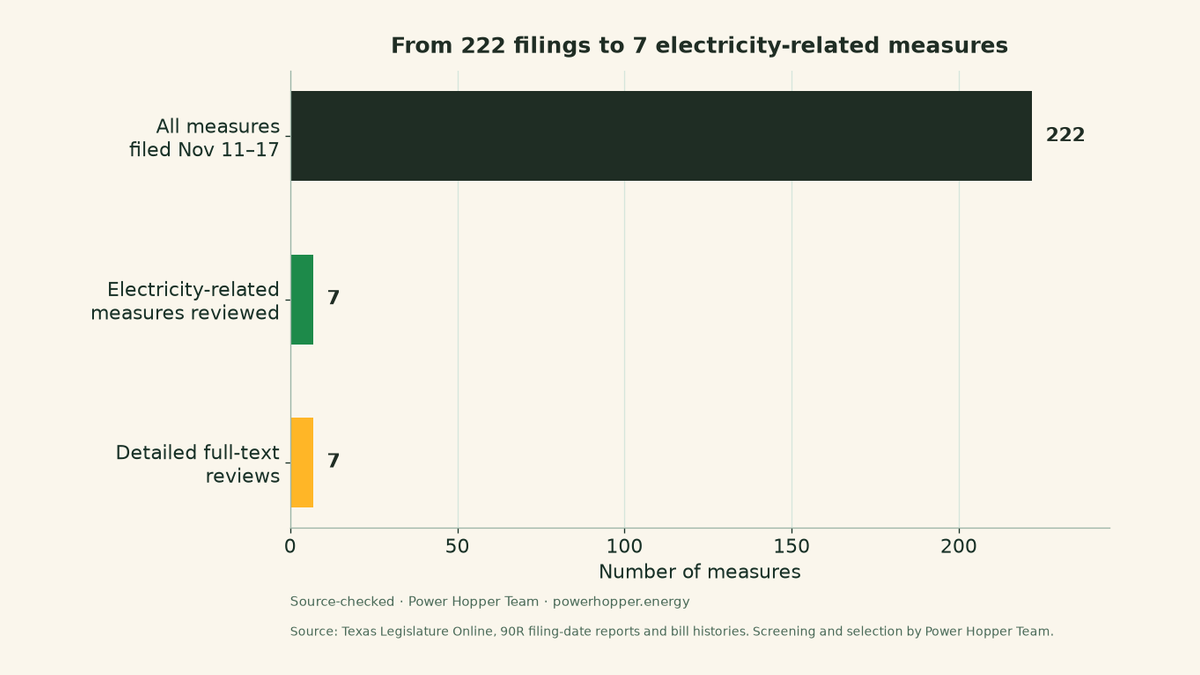
The short version. Lawmakers are pre-filing bills for the Texas legislative session that starts in January 2027. From Nov. 11 to 17, 2026, they filed 222 measures. Most have nothing to do with electricity. Seven could touch what you pay, or whether your power stays on. Every one of them is filed only — none is law, and none has even reached a committee. Filing a bill changes nothing on your bill today.
How we got to seven
We read the official filing list for each of the seven days. Nothing was filed on Nov. 11, 14 or 15. We screened every caption and read the full text of the bills that could affect electricity customers. Seven qualified.
The seven bills, in plain English
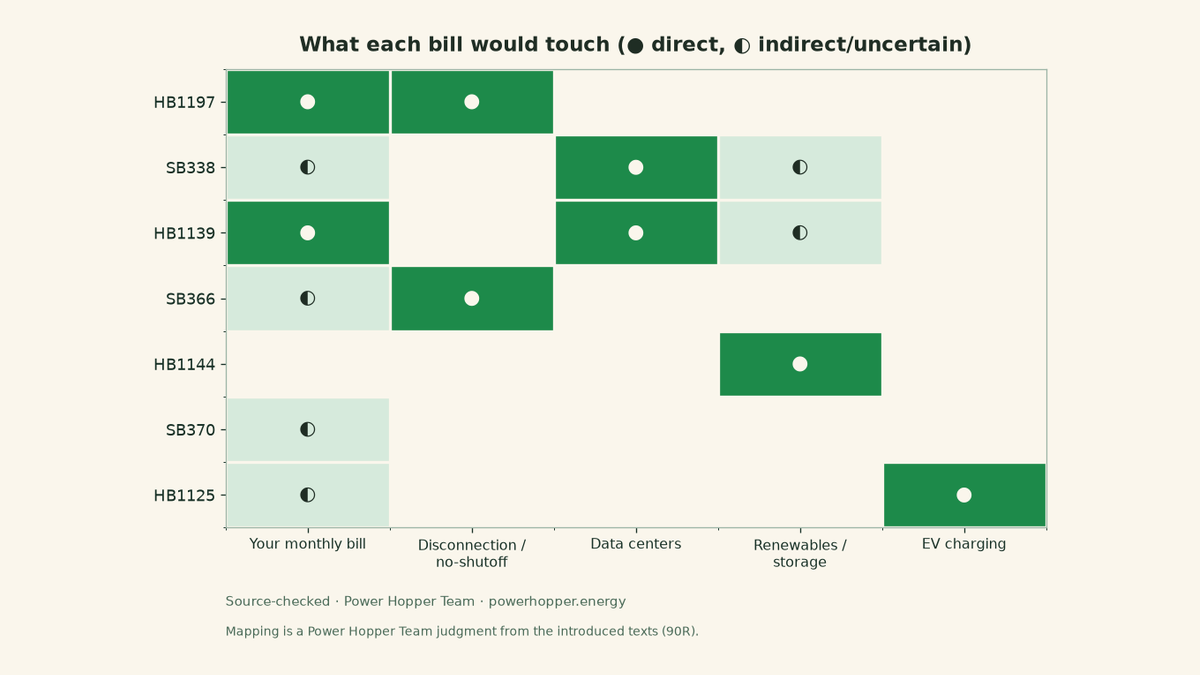
HB1197 (Rep. Hernandez) — a state fund to help pay electricity bills. Would create a state fund to help people pay power bills during extreme weather, plus one-time help for critical-care customers who are about to be cut off for nonpayment. The Public Utility Commission (PUCT) would set the rules and pay providers back; the state health agency would identify who qualifies. If it passes, a qualifying household's bill would go down by the help it receives. There is no new surcharge in the bill. How much help, and for whom, would depend on how much money the state puts in. Effective Sept. 1, 2027 if enacted. This was the only electricity-related bill filed on Nov. 17.
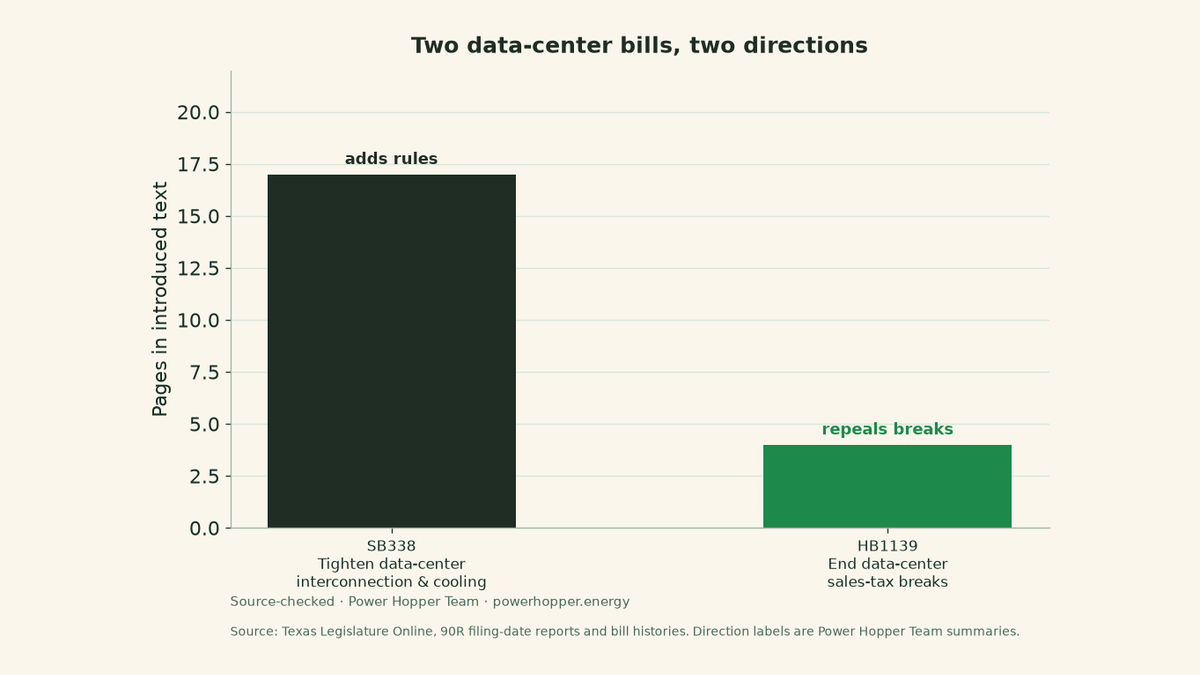
SB338 (Sen. Perry and 20 coauthors) — new rules for big data centers. Would make large ERCOT data centers register and would tie their grid connection to cooling and water-use disclosures. If a data center near you had to meet these rules, it could change the project's cost and timing. Any effect on your own bill is unclear. Effective Sept. 1, 2027 if enacted.
HB1139 (Rep. Jessica González) — end data-center tax breaks. Would repeal the sales-tax exemptions some data centers get, including on the electricity they use. That would raise those operators' costs. It does not change household rates directly. It could take effect immediately if two-thirds of each chamber votes for it; otherwise Sept. 1, 2027.
SB366 (Sen. Molly Cook) — more protection from shutoffs. Would add a governor-declared weather disaster to the events that stop a provider from cutting off your power. During a covered emergency, you could not be disconnected and could spread out payments. It changes the timing of what you owe, not the total. Effective Sept. 1, 2027 if enacted.
HB1144 (Rep. Landgraf) — clean-energy grant money. Would rework the state's emissions-reduction grants and keep a minimum set-aside for renewable-energy storage while removing hydrogen from that pool. No direct effect on your bill. Effective Sept. 1, 2027 if enacted.
SB370 (Sen. Molly Cook) — study burying power lines. Would order the PUCT to study burying overhead distribution lines in Austin, Dallas–Fort Worth, Houston and San Antonio, weighing cost, outage savings and safety. It is a study only; any cost or reliability effect would come from later decisions. The PUCT would report by Dec. 31, 2028. Effective Sept. 1, 2027 if enacted.
HB1125 (Rep. Bhojani) — chargers at new state parking. Would require electric-vehicle chargers at covered new state parking lots and garages. No direct effect on your home bill; it could raise electricity use at those state sites. Effective Sept. 1, 2027 if enacted.
Two clusters worth watching
Two of the bills are about data centers pulling more power onto the Texas grid: SB338 would add rules, and HB1139 would end tax breaks. Two others are about households that fall behind: HB1197 would create bill help, and SB366 would widen the shutoff protections.
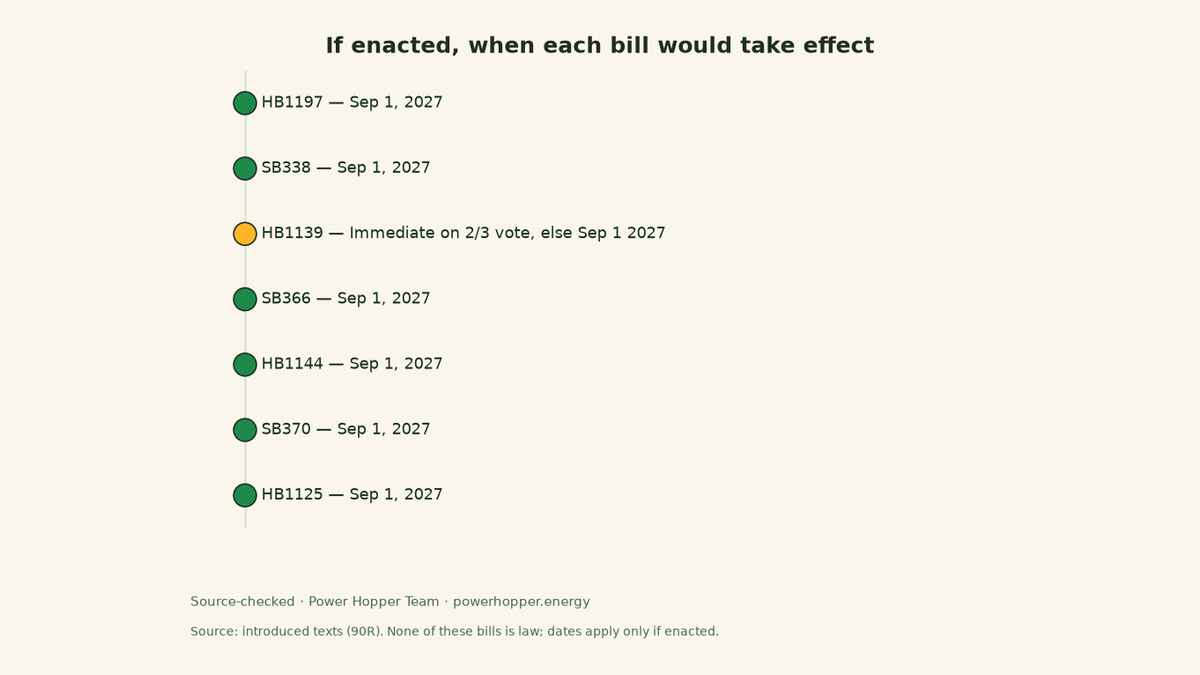
When these would take effect
None of the seven is law. If the Legislature passes them and the governor signs, six would take effect Sept. 1, 2027. HB1139 could take effect sooner if two-thirds of each chamber votes for it.
What to watch next
- Whether any of the seven gets referred to a committee and a hearing is set.
- For HB1197, whether lawmakers set aside enough money to start and keep the fund going.
- For SB338 and HB1139, how data-center growth and its grid costs get shared.
Sources
- Texas Legislature Online: bills filed Nov. 17, 2026 (90R)
- Bills filed Nov. 16, 2026 (90R)
- Bills filed Nov. 13, 2026 (90R)
- Bills filed Nov. 12, 2026 (90R)
- Power Hopper Media Data Room: full dataset, 12 charts and the Nov. 17 roster
Power Hopper is not affiliated with or endorsed by the organizations named above. This brief was prepared with AI assistance. Power Hopper is a PUCT-registered Texas electricity broker and earns a commission when a customer enrolls through us. That never decides what we cover or how.
BJW Ventures LLC d/b/a Power Hopper, PUCT Registered Electricity Broker BR260201