
The short version. From Oct 26 to Nov 1, 2026, utilities, a generator, the governor's office, a House committee chair and the PUCT spoke to one question: when data centers and other very large users connect to the ERCOT grid, who pays for the wires? Utilities say growth could spread fixed costs: CenterPoint forecasts about $5 billion in savings over a decade, and AEP estimates up to $21 billion in fixed cost offsets in its vertically integrated states. Both are company forecasts, not results. The one per-household figure we found is in a PUCT filing: CenterPoint Houston's residential delivery bill rises about $1.19 a month at 1,000 kWh under interim rates.
The question behind the headlines
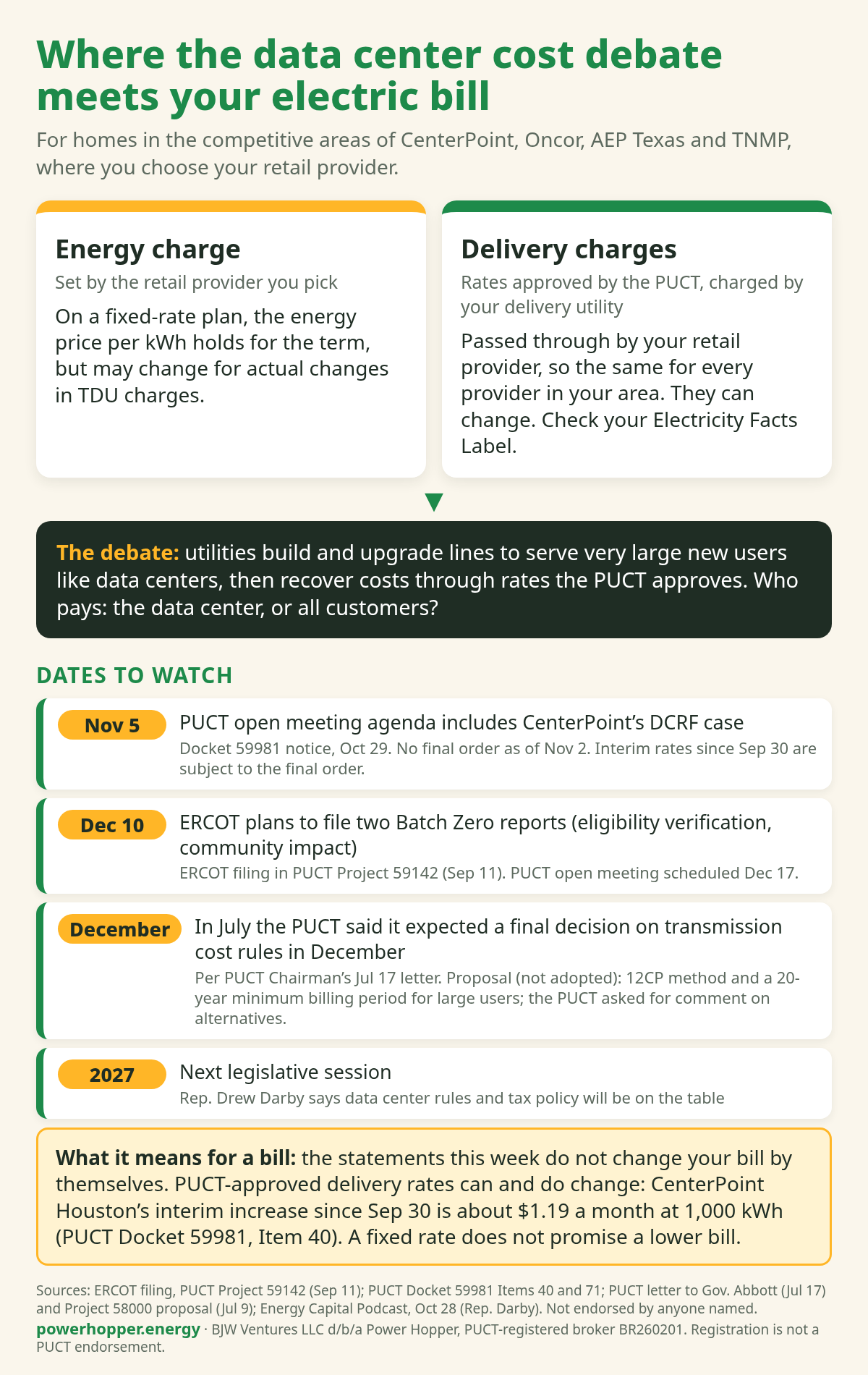
Senate Bill 6 (2025) set interconnection rules for "large loads," 75 MW or more at one site by default, including data centers. On Aug 3, Gov. Greg Abbott directed the PUCT and ERCOT to run a "comprehensive verification and audit" of data centers in the interconnection process. ERCOT paused approvals to energize new large-load data centers under its Batch Zero process. It told the PUCT it plans to file two reports on Dec 10, an eligibility verification report and a community impact review report, ahead of a Dec 17 PUCT open meeting. New lines are recovered through transmission and distribution rates the PUCT approves. Who ultimately pays, the data center or all customers, is the open point.
Utilities: growth can spread fixed costs
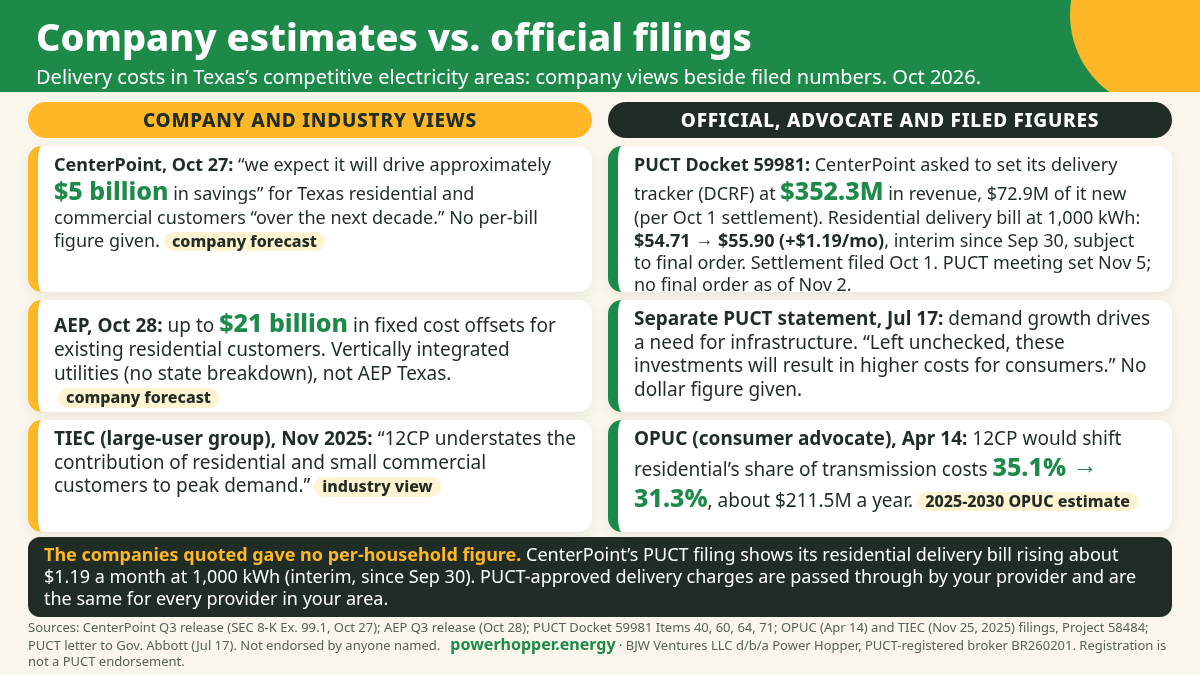
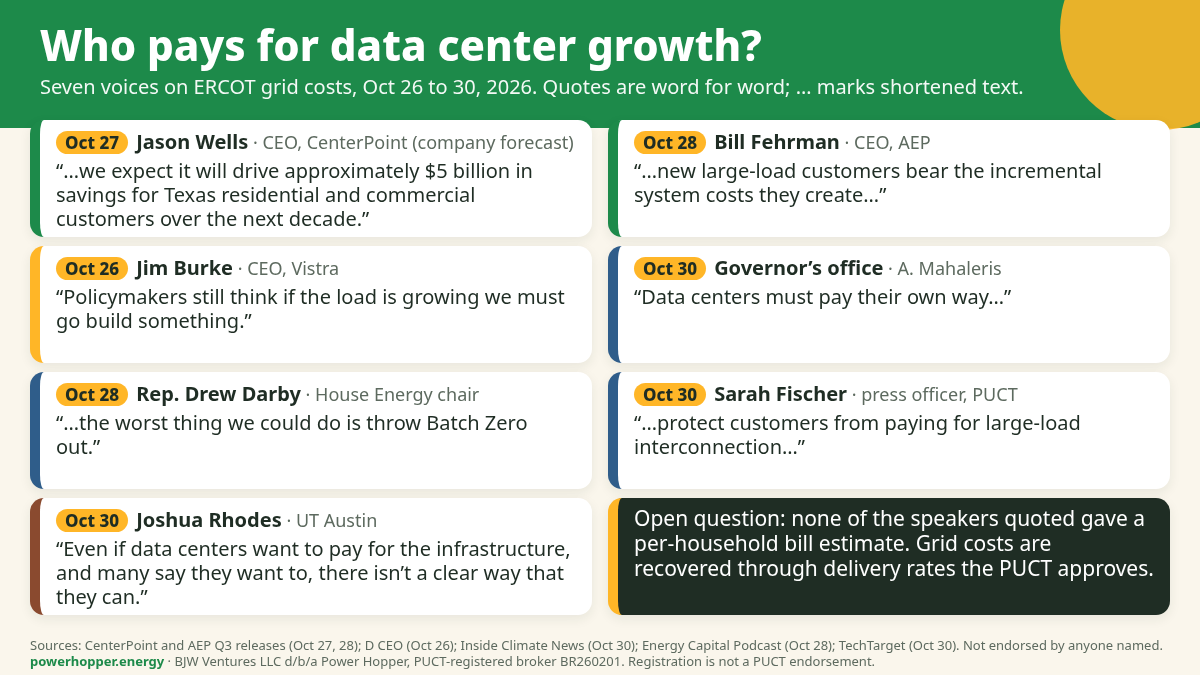
CenterPoint Energy, Oct 27. In its Q3 release, CEO Jason Wells said: "This growth also supports affordability as we expect it will drive approximately $5 billion in savings for Texas residential and commercial customers over the next decade." That is CenterPoint's own forecast. It also raised its 10-year capital plan by $4.0 billion, to $70.7 billion.
AEP, Oct 28. In its Q3 release, CEO Bill Fehrman said AEP "is committed to having new large-load customers bear the incremental system costs they create and fund the investments required to serve them." The release says contracts in AEP's vertically integrated states could produce "up to $21 billion in fixed cost offsets" for existing residential customers, with no state breakdown. Those utilities include SWEPCo, which serves east Texas and the Texas Panhandle outside retail-choice areas. The figure is not for AEP Texas, the delivery company in competitive areas.
Company estimates next to official figures
- CenterPoint's $5 billion forecast and its filed delivery costs. The forecast has no bill figure. In PUCT Docket 59981, CenterPoint asked to set its distribution cost recovery factor (DCRF), at $352.3 million in revenue, $72.9 million of it new (per the Oct 1 settlement). Its rate transparency filing (Item 40) lists the residential delivery bill at 1,000 kWh as $54.71 now and $55.90 with the new DCRF, up $1.19 a month. Interim rates have applied since Sept 30, subject to the final order. A judge's Sept 14 proposal for decision recommended approval, and CenterPoint, PUCT staff, the City of Houston and the Gulf Coast Coalition of Cities filed a settlement Oct 1; three other parties do not oppose it. The Nov 5 PUCT open meeting agenda includes the docket. No final order had been filed as of Nov 2.
- AEP's $21 billion estimate and a PUCT statement on costs. AEP's figure is for its vertically integrated utilities, not AEP Texas. Separately, the PUCT told the governor on July 17 that demand growth, "primarily attributable to new large computational loads," is "driving a significant need for additional infrastructure," and: "Left unchecked, these investments will result in higher costs for consumers." The letter adds that the report recommended changes to require large loads to pay for infrastructure required to serve them. It gives no dollar figure.
- Who bears transmission costs. The Office of Public Utility Counsel (OPUC), an advocate for residential and small commercial consumers, estimated on April 14, with its own model, that moving from 4CP to 12CP would cut the residential share of transmission costs from 35.1% to 31.3% for 2025 to 2030, about $211.5 million a year. That shifts cost share among customer classes. It is not a bill cut or a PUCT finding. In November 2025, Texas Industrial Energy Consumers, a large-user group, told the PUCT that "12CP understates the contribution of residential and small commercial customers to peak demand."
Generators and state officials
Vistra, Oct 26. In D CEO's November issue, CEO Jim Burke said: "Policymakers still think if the load is growing we must go build something." Vistra owns power plants and a retail electricity provider.
Governor's office, Oct 30. Press secretary Andrew Mahaleris told Inside Climate News: "Data centers must pay their own way, protect our grid and water, and complete the ERCOT and TWDB audits."
Rep. Drew Darby, Oct 28. The House Energy Resources chair told the Energy Capital Podcast that "the worst thing we could do is throw Batch Zero out," arguing that delaying it further would slow connecting generation to the grid.
PUCT, Oct 30. Press officer Sarah Fischer told TechTarget: "These adopted and proposed rules will protect customers from paying for large-load interconnection and improve grid planning." TechTarget reports the "adopted" rule is the large-load interconnection standard (Project 58481, effective Oct 8); the "proposed" transmission cost rule (Project 58000) is not adopted.
Analysts and critics: is the money really protected?
Joshua Rhodes, UT Austin, Oct 30 (TechTarget): "Even if data centers want to pay for the infrastructure, and many say they want to, there isn't a clear way that they can."
The PUCT's July 9 Project 58000 proposal would replace 4CP with 12CP and fix a 20-year minimum billing period for large users. Comments closed Aug 11; the PUCT asked whether the 20 years should be fixed, phased down or longer. In July the PUCT said it expected a final decision in December 2026.
A University of Houston Hobby School survey (Oct 10 to 14, 2,000 likely voters, ±2.19%) found 99% say data centers should cover grid expansion costs.
Where they agree and differ
The governor's office and Rep. Darby say data centers should pay their way. The PUCT says its rules are meant to protect customers from paying for large-load interconnection. Our reading: the Dec 10 ERCOT reports, the PUCT's transmission cost decision and the 2027 legislative session are the next dates to watch.
What it means if you shop for electricity
Delivery charges (also called TDU charges) are billed by your local delivery utility at rates the PUCT approves. Your retail electricity provider passes them through on your bill, so they are the same whichever provider you pick in that utility's area. This applies in the competitive areas of CenterPoint, Oncor, AEP Texas and TNMP. On a fixed-rate plan, the energy price per kWh holds for the term, but the price may change to reflect actual changes in TDU charges (16 TAC §25.475). Check the Electricity Facts Label. The statements in this article do not change a bill by themselves, but PUCT-approved delivery rates do change on their own schedule, as CenterPoint Houston's interim increase since Sept 30 shows. A fixed rate does not promise a lower bill.
Compare fixed-rate plans for your ZIP code at powerhopper.energy, if you live in one of Texas's competitive electricity areas. Power Hopper (BJW Ventures LLC d/b/a Power Hopper) is a PUCT-registered electricity broker, BR260201; registration is not a PUCT endorsement. Electricity providers may pay us a commission if you sign up through us.
What we could not verify
- CenterPoint's and AEP's savings figures are company forecasts we cannot check.
- Fischer's and Rhodes's quotes come via TechTarget, and the governor's statement via Inside Climate News; we found no original releases. Darby's quote was checked against the podcast transcript.
- Docket 59981 is on the Nov 5 PUCT agenda; the outcome may change the figures above.
Sources
Company and regulator documents:
- CenterPoint Q3 2026 release, Oct 27: investor site; SEC Exhibit 99.1.
- AEP Q3 2026 release, Oct 28: 8-K Exhibit 99.1.
- PUCT Docket 59981, CenterPoint DCRF: rate transparency document, Item 40, Aug 20; proposal for decision, Item 60, Sep 14; stipulation, Item 64, Oct 1; Nov 5 agenda notice, Item 71, Oct 29; filing list.
- PUCT Chairman Gleeson letter to Gov. Abbott, Jul 17: Project 58317 filing.
- OPUC initial comments, Project 58484, Apr 14: filing; TIEC comments, Nov 25, 2025: filing.
- PUCT Project 58000 proposal for publication, Jul 9: Item 8; filing list.
- PUCT Project 58481, large-load interconnection standards, order adopting 16 TAC §25.194, Sep 18, effective Oct 8: filing list.
- Governor Abbott press release, Aug 3: data center audit directive.
- ERCOT Batch Zero update, PUCT Project 59142, Sep 11: filing.
- Senate Bill 6 (89th Legislature): enrolled text. PUCT rule on fixed-rate products: 16 TAC §25.475.
- University of Houston Hobby School survey, Oct 27: UH news.
News reports, transcripts and interviews:
- D CEO, Nov 2026 issue, Oct 26: Ahead of the surge.
- Inside Climate News, Oct 30: Texas data center pushback.
- Energy Capital Podcast, Oct 28: Data centers have to earn rural Texas.
- TechTarget, Oct 30: Poll on data centers funding grid upgrades.
Power Hopper is not affiliated with or endorsed by the organizations named above, including the PUCT and ERCOT. This brief was prepared with AI assistance. Reviewed by Brent Ward on November 2, 2026.
Power Hopper (BJW Ventures LLC d/b/a Power Hopper) is a PUCT-registered electricity broker, BR260201; registration is not a PUCT endorsement. Electricity providers may pay us a commission if you sign up through us. Power Hopper is not a retail electric provider or a utility.