
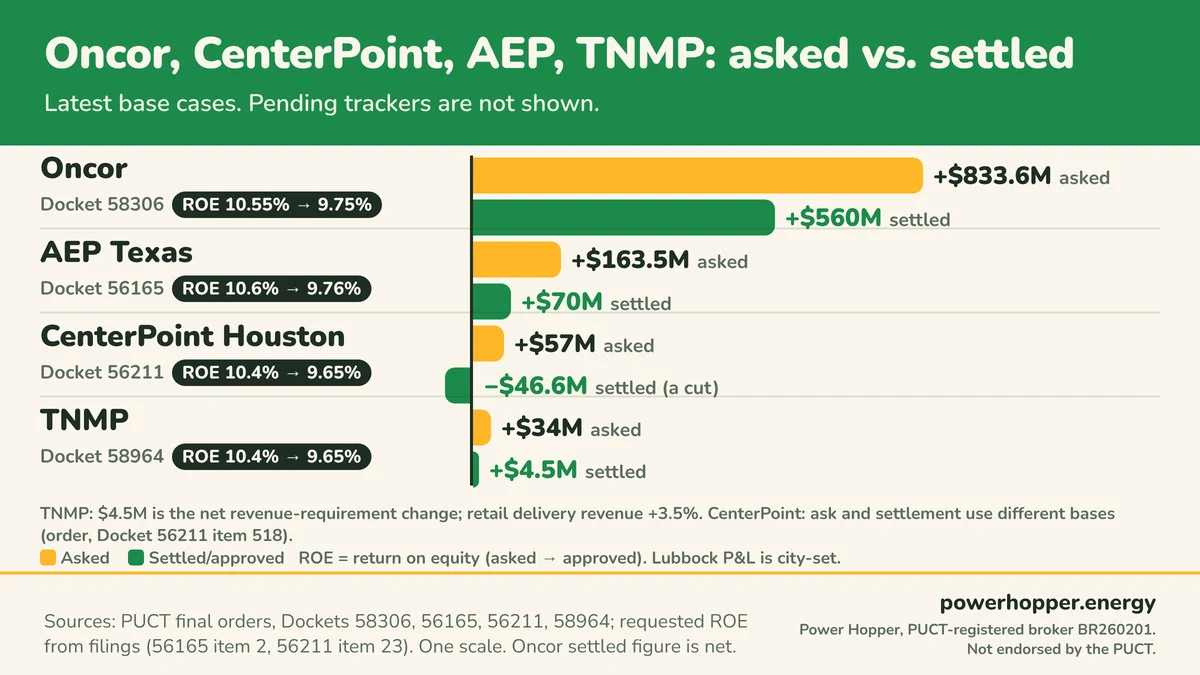
The short version. If you live in one of Texas's competitive electricity areas, your delivery charge is set in a rate case, not by your electricity plan. In four recent base-rate cases, every utility asked for more than it got, and in one (CenterPoint Houston, 2025) the approved change was a cut. Oncor, the largest, asked for about $833.6 million more per year and settled at about $560 million. Three proceedings are still open: Oncor's annual cost tracker (Docket 59249), CenterPoint's distribution tracker (59981, on the PUCT's Nov 5 agenda) and AEP Texas's refund filing (60032). Where a utility's own bill estimate and the figure in the PUCT's monthly reports differ, we show both side by side. For Oncor's tracker they are +$3.84 (Oncor's filing) and +$8.37 (PUCT-reported) a month at 1,000 kWh, and we explain the gap below. Every estimate is labeled with its method, and our own arithmetic is labeled as ours.
At a glance
- Oncor: asked +$833.6M (ROE 10.55%). Settled at about +$560M net, ROE 9.75%. Order Apr 17, 2026 (Docket 58306). Tracker Docket 59249 pending.
- CenterPoint Houston: asked about +$57M (ROE 10.40%). Settled at about a $46.6M cut, ROE 9.65%. Order Mar 13, 2025 (Docket 56211). DCRF Docket 59981 is on the PUCT's Nov 5 agenda.
- AEP Texas (Central and North): asked +$163.5M (ROE 10.6%). Settled at +$70M, ROE 9.76%. Order Oct 3, 2024 (Docket 56165). Tracker Docket 58315 decided Jul 30, 2026; refund Docket 60032 pending.
- TNMP: asked about +$34M (ROE 10.4%). Settled at +$4.5M, ROE 9.65%. Order Jul 30, 2026 (Docket 58964).
- Lubbock Power & Light (LP&L): city-owned, so no PUCT rate case. New delivery tariff effective Nov 1, 2026: $2.50 a month plus 6.008¢ per kWh.
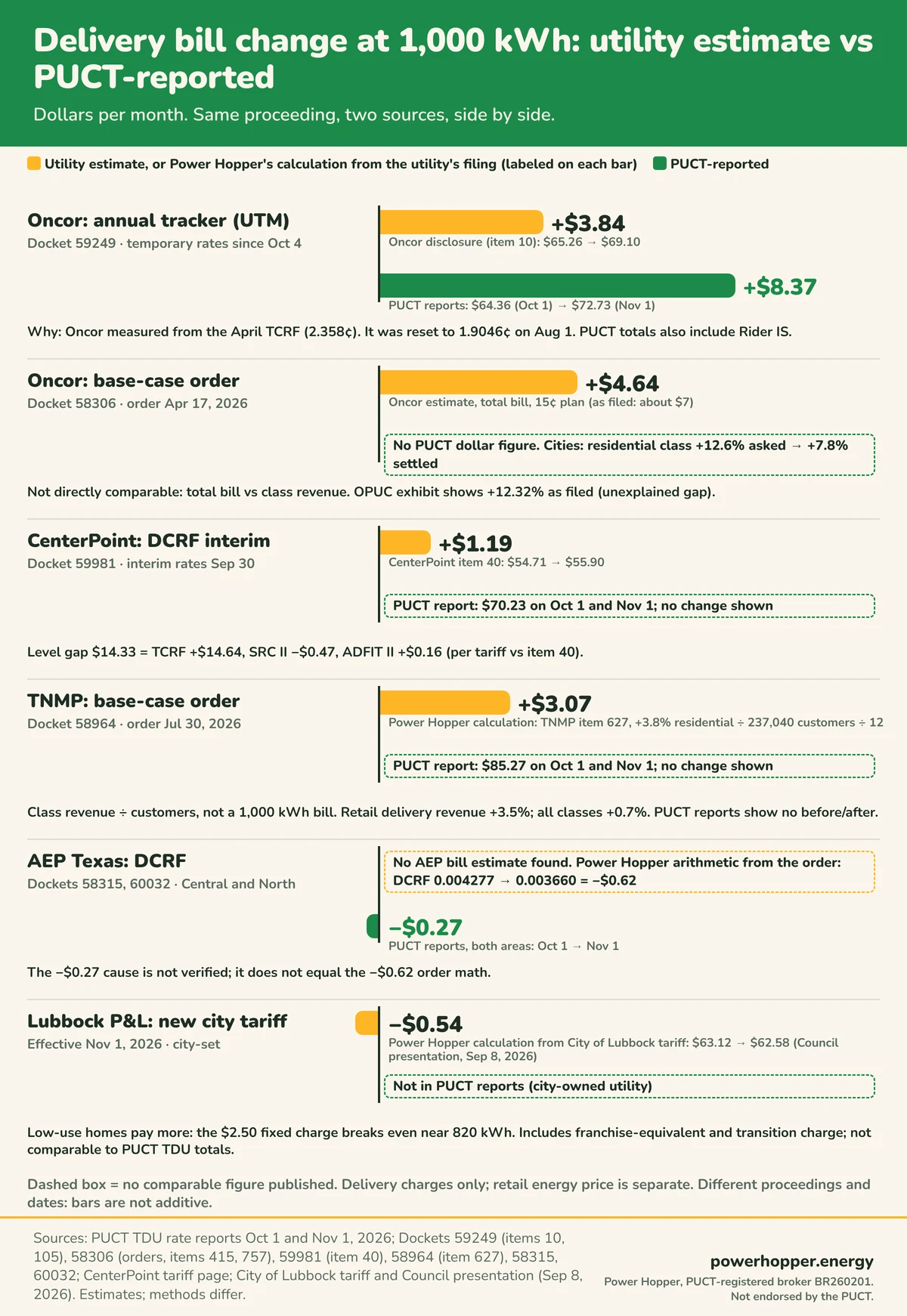
Utility estimates, PUCT-reported figures and our own arithmetic, monthly change at 1,000 kWh:
- Oncor tracker (59249): utility estimate +$3.84 (Oncor's disclosure, $65.26 to $69.10); PUCT-reported +$8.37 ($64.36 on Oct 1 to $72.73 on Nov 1).
- Oncor base case (58306): utility estimate +$4.64 (about 3%, assumes a 15¢ plan; about $7 as filed); PUCT-reported dollar figure: none found. Cities report the residential class at +7.8% settled.
- CenterPoint tracker (59981): utility estimate +$1.19 (interim DCRF, $54.71 to $55.90); PUCT-reported level $70.23 on both Oct 1 and Nov 1, with no separate change shown.
- TNMP (58964): no TNMP per-customer figure; our calculation from its filing is about +$3.07 per residential customer (class revenue +3.8%); PUCT-reported level $85.27 on both dates, no change shown.
- AEP Texas (58315): no AEP bill estimate found; our arithmetic from the order is −$0.62 (distribution factor, final vs temporary); PUCT-reported −$0.27 (Oct 1 to Nov 1), cause not verified.
How delivery charges reach your bill
Your retail electricity provider (REP) sells you the energy. Your wires company, a transmission and distribution utility (TDU), moves it to your home. The PUCT regulates what TDUs in competitive areas charge, not what REPs charge, as the PUCT's bill guide explains. Municipal utilities like LP&L and co-ops set their own delivery rates locally; the PUCT does not set them in a base-rate case.
A rate case sets how much a TDU may collect each year (its revenue requirement): costs are added up, a return is allowed on the equity share of its investment (ROE), and the total is split across customer classes. Between cases, trackers update parts of the rates: the distribution cost recovery factor (DCRF), the transmission cost recovery factor (TCRF), and the unified tracking mechanism (UTM, from House Bill 5247), which updates them in one proceeding.
What you can't control. Which TDU serves your address, and its rates. A fixed-rate plan fixes the REP's energy price, but TDU charges are typically passed through and can change during your contract; the plan's Electricity Facts Label says how (16 TAC §25.475). What you can. Your plan, provider and usage. Cities and the Office of Public Utility Counsel (OPUC) represent customers in these cases.
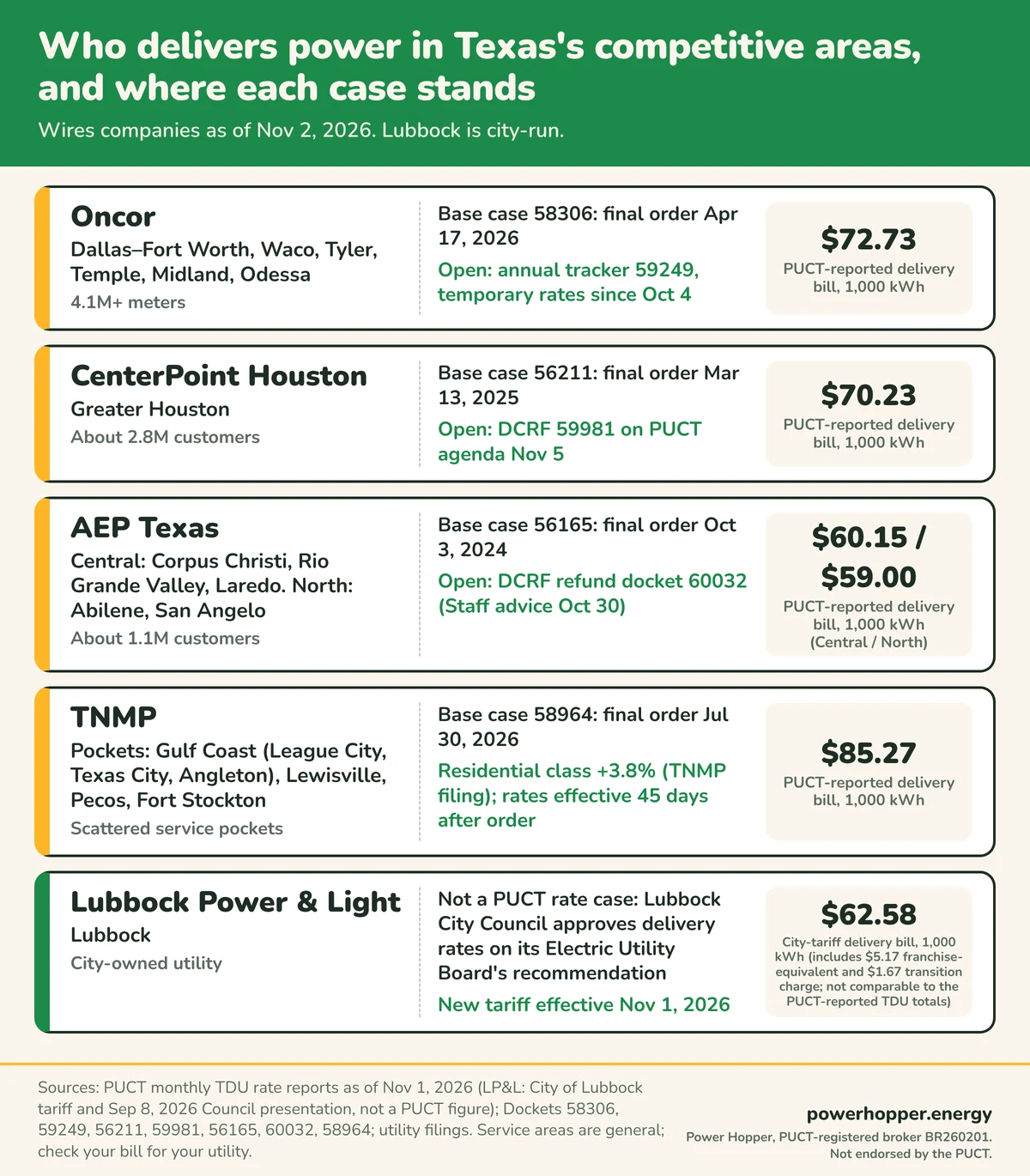
Oncor (more than 4.1 million meters; Dallas–Fort Worth, Waco, Tyler, Midland, Odessa)
Base case, Docket 58306. Oncor filed on Jun 26, 2025 on a test year ending Dec 31, 2024. It asked for about $833.6 million a year more ($659.3 million distribution, $174.3 million transmission), roughly 13% on about $6.4 billion of annual revenue, with a 10.55% ROE and 45% equity. Oncor's rate-case page gives three drivers: about 45% storm costs (over $350 million a year spent in 2021–2024, against a $122 million annual reserve), about 20% inflation, and about 25% financial strength and borrowing costs. It cites a $36.1 billion 2025–2029 capital plan (a newer plan of $47.5 billion for 2026–2030 appears in its February 2026 results release).
What others argued. PUCT Staff's rate-of-return witness put Oncor's cost of equity at 9.15%–10.35% and recommended 9.75%, a 56.5% debt and 43.5% equity structure, for a 6.90% overall return versus Oncor's 7.47% (item 474). An OPUC rate-design exhibit showed the residential class taking a 12.32% increase at Oncor's requested revenue (item 415). OPUC signed the settlement; we did not find its ROE position.
Settlement. An unopposed settlement filed Jan 29, 2026 was approved Apr 17, 2026. Signers included Staff, OPUC, cities, Walmart and Google. It set a net increase of about $560 million ($456.8 million distribution, $103.2 million transmission), a $6,970,128,383 total base revenue requirement (up about 8.7%, our calculation), ROE 9.75%, 56.5% debt, a 7.032% overall return, and a storm reserve raised to $200 million a year. ROE and capital structure match Staff's recommendation. Oncor may bill the difference back to Jan 1, 2026 through a surcharge. The order's figures give a cut of about $273.6 million, or 33% ($833.6M − $560M, our calculation). The Steering Committee of Cities cites $263 million; we could not reconcile that with the order's figure.
Still pending, Docket 59249 (UTM). Oncor filed on Apr 22, 2026. Its rate disclosure (item 10) shows increases of $540.6 million retail distribution, $133.9 million retail transmission and $332.8 million wholesale transmission, about $1 billion in all. It cited the Permian Basin Reliability Plan, load growth and storm resiliency. The PUCT did not rule within the 120-day limit, so temporary rates began with bills rendered on or after Oct 4, 2026, subject to refund or surcharge. After an Aug 20 hearing and briefs through Sep 18, OPUC wants return and capitalized-cost items removed and recovery stretched to 18 months, Staff trimmed distribution by about $4.5 million, and the Steering Committee of Cities proposes cuts of about $18.6 million (distribution) and $22.5 million (transmission). No ruling yet.
Utility estimate, PUCT-reported figures and our calculation. Tracker: Oncor's April disclosure (item 10) shows +$3.84 at 1,000 kWh, from $65.26 to $69.10. The PUCT's monthly reports show Oncor's residential delivery at $64.36 on Oct 1 and $72.73 on Nov 1, a rise of +$8.37. The Nov 1 figure matches Oncor's tariff: $1.48 customer + $2.58 meter + 6.8673¢ × 1,000 kWh = $72.73. The filings explain the gap. Oncor measured from the transmission cost factor in effect in April (2.358¢), but an Aug 1 update had already lowered it to 1.9046¢, so the real step up to the new 2.1669¢ was larger (+0.2623¢ transmission and +0.5755¢ distribution = +0.8378¢, or $8.38 at 1,000 kWh). Oncor's disclosure also leaves out Rider IS (0.3633¢, or $3.63), which the PUCT total includes; that is why Oncor's starting level ($65.26) is above the PUCT's ($64.36). The Oct 1 PUCT figure and the Rider IS rate rest on a secondary source (EnergyChoiceMatters); our rebuild from the tariff matches the PUCT total to the cent.
Base case: Oncor's own figure at settlement was about +$4.64 a month at 1,000 kWh (about 3%, on an assumed 15¢ per kWh plan; about $7, or 4.7%, as filed), per Oncor's rate-case page. We did not find a PUCT-reported dollar figure for the base case. The parties' numbers are class percentages: the residential class at +12.32% as filed per OPUC's exhibit, +12.6% per Cities, and +7.8% settled per Cities. Those measure class delivery revenue, not a total bill, so they are not comparable to the dollar estimate. The 12.32% versus 12.6% difference is unexplained.
CenterPoint Energy Houston Electric (about 2.8 million customers)
Base case, Docket 56211. Filed Mar 6, 2024 (test year 2023). CenterPoint asked for about $57 million more (roughly $15 million retail and $42 million wholesale transmission) with a 10.40% ROE (item 23). The ask excludes the transmission cost recovery factor and rate-case expense, while the settlement's $46.6 million cut is measured against $2.305 billion of present revenues, so the two are on different bases (order, item 518). A settlement filed Jan 29, 2025, signed by CenterPoint, Staff, OPUC, the cities, the REP Coalition and others, set ROE at 9.65%, 56.75% debt and a 6.606% overall return. The PUCT approved it Mar 13, 2025; the order set rates no earlier than the 46th day after (Apr 28). The City of Houston estimated about $0.82 a month less for the average residential customer; we did not find a CenterPoint estimate.
DCRF Docket 59424. Filed Feb 27, 2026 for a $286.2 million annual distribution revenue requirement; a settlement agreed to $280.0 million. The PUCT's Jul 9, 2026 order approved the DCRF rates (residential $0.004944 per kWh) but rejected deferring about $52.3 million in resiliency costs, finding the evidence sufficient for only $3.4 million.
DCRF Docket 59981 (pending). Filed Jul 17, 2026 for $352.3 million, about $72 million above the last DCRF. Interim rates began Sep 30. The judge's Sep 14 proposal recommended approval as filed, with Staff in support; the Texas Coast Utilities Coalition sought a $12.6 million cut over tax treatment of operating losses. A stipulation filed Oct 1 (CenterPoint, Staff, the City of Houston and the Gulf Coast Coalition of Cities, unopposed) keeps the $352.3 million, uses a 6.606% rate on a $1.1 million refund, and requires a full review of resiliency accounting in the next base case. It is on the PUCT's 9:30 a.m. Nov 5, 2026 open-meeting agenda.
Resiliency and storms. The resiliency plan (Docket 57579) was filed Jan 31, 2025 and sought about $5.75 billion, per KPRC (a news report; the order does not state that figure). The plan approved in Nov 2025 includes measures the agreement estimates at $3.1781 billion, with $242 million of cost recovery deferred (order, Docket 57579 item 305, findings 62 and 165). KPRC reported $2.9 billion, consistent with that less the deferral (about $2.94 billion, our arithmetic), though KPRC does not say how it got its number. Separately, CenterPoint issued $1.193 billion of storm-restoration bonds in February 2026 (investor page); the tariff-page charge nets to about $2.43 at 1,000 kWh ($0.002848 less a $0.000418 credit).
Utility estimate, PUCT-reported figures and our calculation. CenterPoint's rate sheet (Docket 59981, item 40, filed Aug 20) shows the interim DCRF rising from $0.004944 to $0.006137 per kWh: +$1.19 a month at 1,000 kWh ($54.71 to $55.90). The PUCT's reports show total residential delivery at $70.23 on both Oct 1 and Nov 1; because interim rates started Sep 30, they show no separate change. The two totals differ by $14.33, and the filings explain it. CenterPoint's tariff page now lists a transmission factor of $0.030812 (item 40 used $0.016173, +$14.64), a lower system restoration charge II ($0.000636 vs $0.001110, −$0.47) and a smaller credit (−$0.000023 vs −$0.000187, +$0.16). $55.90 + $14.64 − $0.47 + $0.16 = $70.23. We did not find the date the transmission factor changed.
AEP Texas (about 1.1 million customers)
Base case, Docket 56165. Filed Feb 29, 2024, asking for $163.5 million more ($100.4 million distribution, $63.1 million transmission) with a 10.6% ROE (application, item 2). An unopposed agreement filed Jul 25, 2024 (Staff, OPUC, cities, TIEC, Walmart, the Navy and others) set a $70 million increase ($45.5 million distribution, $24.5 million transmission), ROE 9.76%, 57.5% debt and a 6.66% overall return. The PUCT order is dated Oct 3, 2024; interim rates had begun Oct 1, 2024, and final rates took effect 45 days after the order.
Tracker, Docket 58315 (the first UTM). AEP filed Oct 6, 2025. The PUCT's Jul 30, 2026 order set final factors after 297 days against a 120-day target, which cities flagged. Temporary rates ran from Mar 20, 2026. The final residential distribution factor is $0.003660 per kWh versus $0.004277 requested.
Refund Docket 60032 (pending). AEP proposed a $7.7 million credit with interest for the gap between temporary and final rates. Staff said on Oct 30 that it complies. No order yet.
Utility estimate, PUCT-reported figures and our calculation. We did not find an AEP bill-impact estimate for the tracker. Our arithmetic from the order: 0.003660 − 0.004277 = −0.000617 per kWh, or −$0.62 a month at 1,000 kWh. The PUCT's reports put 1,000 kWh at $60.15 (Central) and $59.00 (North) on Nov 1, each −$0.27 from Oct 1. That drop is not the $0.62 difference, and we could not verify its cause.
TNMP (pockets in the Gulf Coast, Lewisville and West Texas)
Base case, Docket 58964. TNMP's first case since 2018. Filed Nov 14, 2025 on a test year ending Jun 30, 2025, it asked for about $34 million (about 5%) over $673 million of adjusted revenue, with 10.4% ROE and 47.54% equity. An unopposed settlement on May 29, 2026 set a $4,499,931 increase to a $677.2 million revenue requirement, ROE 9.65%, cost of debt 5.56%, 55% debt and a 7.40% overall return. Signers included Staff, OPUC, cities, TIEC, Walmart and Hunt. The PUCT approved it Jul 30, 2026; rates take effect 45 days later (about Sep 13 by our count), and a surcharge covers the gap since interim rates began May 22. The order also creates a rider for $20.5 million of Hurricane Beryl costs over five years.
Utility estimate, PUCT-reported figures and our calculation. TNMP's rate-transparency filing (Docket 58964, item 627, Aug 4, 2026) shows revenue by customer class. Residential rises from $227.8 million to $236.5 million: +$8,735,943, or +3.8%, across 237,040 customers. Retail electric delivery revenue as a whole rises $17.2 million (+3.5%). The all-class change is only +0.7% ($672.7 million to $677.2 million) because network transmission revenue falls 6.8%. TNMP did not publish a per-customer figure. Our calculation, class revenue divided by customers and months, is about +$3.07 per residential customer per month ($8,735,943 ÷ 237,040 ÷ 12); that is an average, not a 1,000 kWh bill. The PUCT's reports show TNMP at $85.27 on both Oct 1 and Nov 1, so they show no change; the new base rates apply later.
Lubbock Power & Light
LP&L's delivery rates are approved by the Lubbock City Council on the recommendation of its Electric Utility Board. For bills on or after Nov 1, 2026, the residential tariff is $2.50 a month plus 6.008¢ per kWh ($0.05324 delivery, $0.00167 transition, $0.00517 franchise-equivalent), or $62.58 at 1,000 kWh. The City's Sep 8, 2026 Council presentation shows the prior residential rate at 6.312¢, or $63.12 at 1,000 kWh. Our calculation: 1,000 kWh costs $0.54 less ($63.12 − $62.58), and use below about 822 kWh costs more (break-even: $2.50 ÷ 0.304¢). These figures include the franchise-equivalent ($5.17 at 1,000 kWh) and the transition charge, so they are not comparable to the PUCT-reported TDU totals above.
What the numbers add up to
In these four base cases, the utility asked for a higher ROE than it ended up with, and all four ended in unopposed agreements. Oncor's approved ROE and capital structure equal Staff's recommendation; we did not check that for the others. The utilities point to storm costs, load growth and large capital plans. Staff and customer groups pushed back on return, tax and capital items, and the PUCT rejected part of CenterPoint's resiliency-cost deferral in Docket 59424. Open questions: whether trackers like the UTM leave enough time for review, and how bills add up when several smaller riders land at once.
What to watch next
- Nov 5: the PUCT's open meeting, where CenterPoint's Docket 59981 is on the agenda. Oncor reports third-quarter results the same day.
- Docket 59249: a proposal for decision and final order on Oncor's tracker, which could mean a refund or surcharge on top of temporary rates.
Delivery charges are typically passed through at the same rates by every provider at your address. The energy price, the plan term and the fees are not. If you want to see how plans compare at your usage with delivery included, compare plans at powerhopper.energy. Power Hopper is a PUCT-registered broker, BR260201; electricity providers may pay us a commission if you sign up through us.
Sources
- PUCT final order, Docket 58306 (Oncor), item 755
- PUCT Staff testimony, Docket 58306, item 474
- OPUC testimony, Docket 58306, item 415
- Oncor rate-case page
- Cities Served by Oncor summary
- Oncor rate disclosure, Docket 59249, item 10 (Attachment E)
- Temporary rates notice, Docket 59249, item 105
- OPUC position, Docket 59249, item 84
- Staff brief, Docket 59249, item 114
- Cities brief, Docket 59249, item 112
- PUCT final order, Docket 56211 (CenterPoint), item 518
- City of Houston release, Mar 13, 2025
- PUCT order, Docket 59424, item 68
- Proposal for decision, Docket 59981, item 60
- Stipulation, Docket 59981, item 64
- Rate transparency sheet, Docket 59981, item 40
- Open meeting notice, Docket 59981, item 71
- Resiliency plan order, Docket 57579, item 305
- PUCT order, Docket 56165 (AEP Texas), item 431
- PUCT order, Docket 58315 (AEP Texas), item 159
- PUCT order, Docket 58964 (TNMP), item 621
- CenterPoint requested ROE, Docket 56211, item 23; AEP requested ROE, Docket 56165, item 2
- TNMP rate-transparency filing, Docket 58964, item 627; AEP refund filing, Docket 60032, item 13
- CenterPoint Houston electric rates and tariff page
- PUCT monthly TDU rate reports
- LP&L FY2026-27 delivery tariff; City of Lubbock Council presentation, Sep 8, 2026; EnergyChoiceMatters, Sep 17, 2026
- PUCT: understanding your bill
Power Hopper (BJW Ventures LLC d/b/a Power Hopper) is a PUCT-registered electricity broker, BR260201; registration is not a PUCT endorsement. Electricity providers may pay us a commission if you sign up through us. Power Hopper is not a retail electric provider, utility or transmission and distribution utility, and is not affiliated with or endorsed by the PUCT, ERCOT or any utility named above. This brief was prepared with AI assistance.
BJW Ventures LLC d/b/a Power Hopper, PUCT Registered Electricity Broker BR260201